Thanks to Ilaine Church for sending me a copy of this flyer.

Scanned image courtesy of Ilaine Church. (Click on image to enlarge)
Ilaine is the wife of my third cousin, once removed, and shares my love of family history. The Church and Casbon families are related through the marriage of Thomas Hiram Church, Jr. (1866–1951) to Lodema Evaline Casbon (1871–1938) in 1890.[1] Lodema was the daughter of Charles Casbon (1840–1915), the man named at the bottom of the sale flyer. Charles was the brother of Sylvester Casbon, my second great-grandfather.

The tie between the Church and Casbon families is illustrated in this photograph of the 1901 Casbon family reunion. The photo was taken in front of the home of Hiram and Lodema Church at what was then no. 5 Elm Street, Valparaiso, Indiana. Charles (left), Lodema (center), and Hiram (right) are circled.
(Click on image to enlarge)
The sale flyer provides us with some interesting information, and raises questions as well. It tells us the location of Charles’ residence and names it the Russel Johnson farm. It tells us that Charles had quite a few valuable livestock, farm equipment, and personal possessions to sell. Some of my questions are: “Who was Russel Johnson?”, “Why was Charles holding the sale?”, and “What were all those items listed for sale?”
It took a bit of digging, but I learned that Russel Johnson bought the property (located in Morgan township) in a series of transactions in the 1850s. He owned it until 1876 when he sold it to a man named Davison. Davison sold it to Stephen Martin in 1884, and Stephen Martin sold it to Charles Casbon in 1888.[2] So even though Russel Johnson had not owned the property since 1876, his name was still associated with the farm in 1893, probably because he developed and farmed it for twenty years.[3]

Copy of deed record showing Charles Casbon’s purchase from Stephen Martin, September 24, 1888. The land is described as “the South three fourths (S ¾) of the North East quarter and the North west quarter of the South East quarter, All in Section one (1) in Township thirty four (34) North Range six (6) west containing one hundred fifty six (15656) acres more or less.”[4] (Click on image to enlarge)
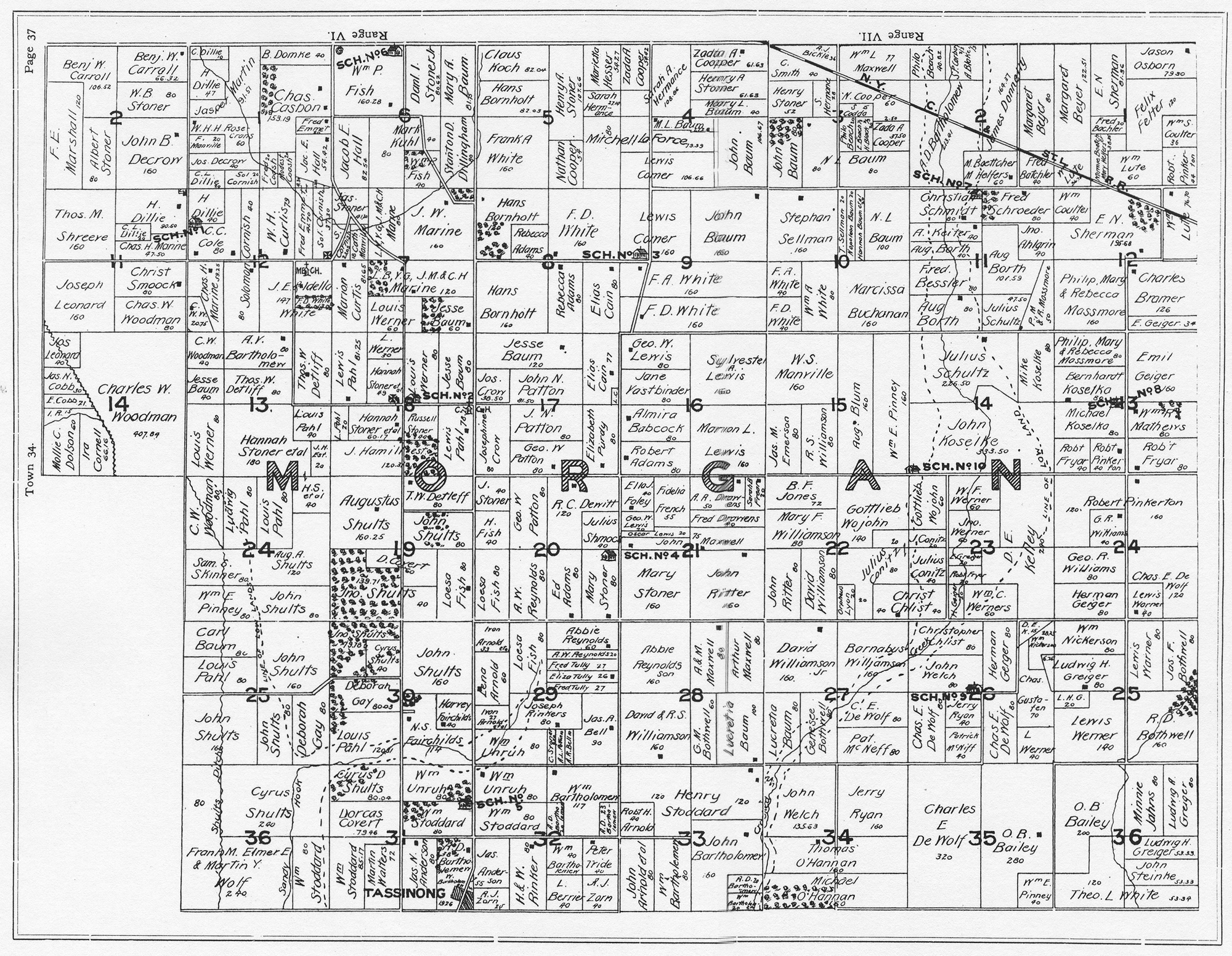
This 1895 plat map shows Charles’ farm, as described in the legal description of
the deed.[5]

Detail of 1895 plat map, Morgan Township, Porter County, Indiana.
(Click on image to enlarge)
This brings me back to the question, “Why was Charles holding the sale?” I wish I knew the answer to this. The extent of the sale would make me think that Charles was liquidating his holdings and selling the farm, but this is not supported by other records. Porter County land records show that Charles didn’t sell the property until 1903.[6] That is the same year he bought property in Valparaiso,[7] and according to The History of Porter County, was “now living retired in a comfortable home on Monroe street in Valparaiso.”[8] Charles’ biography glosses over his life as a farmer and provides no information relevant to the farm sale of 1893. Charles owned several different properties in the county, so maybe he was just “downsizing” and getting rid of excess inventory. Or was he in debt? The best source of information would probably be a contemporary newspaper article, but I don’t have access to the newspapers from that timeframe (they are on microfilm at the Valparaiso Public Library, about 1,000 miles away from me!).
What are all those things he’s selling? Here are some definitions of things that were unfamiliar to me:
“fresh” cows: “cows recently calved and still in their first flush of lactation, that is within 2 weeks, possibly 4 weeks since calving.”[9]
shoat: “a piglet that has recently been weaned”[10]
road cart: “a light 2-wheeled vehicle often with a back”[11]

A road cart. Image available from The Florida Center for Instructional Technology at https://etc.usf.edu/clipart/76200/76249/76249_road-cart.htm
hog rack: I’m not sure, but I found this in the California Hog Book (1915): “on every hog farm there should be one or more solid substantial wagon racks that can be used for hauling hogs safely without fear of the animals breaking out and getting away.”[12]
2-horse rake: Used to rake hay after mowing. I couldn’t find a picture of one with two horses, but this should give you the idea

Image downloaded from “Rake Development Spurred by Mower Technology,”
Farm Collector (https://www.farmcollector.com/implements/rake-development-
spurred-by-mower-technology : accessed 11 November 2017) (Click on image to enlarge)
spring tooth drag: I think this is also called a spring tooth drag harrow, a tool that smooths and loosens the ground after plowing, described as “a largely outdated piece of farm equipment.”[13]

Modern version of a spring-tooth drag harrow. Image adapted from Working Horse Tack
(https://workinghorsetack.com/The-Pioneer-Spring-Tooth-Harrow-p/4303.htm).
Fairbanks scales: Fairbanks was and still is a major manufacturer of scales.[14] How would a 600 lb. capacity scale be used on a farm? To weigh grain?
This simple farm sale flyer doesn’t provide much in the way of genealogical information, but it is still a valuable part of Our Casbon Journey since it connects us to Charles Casbon and gives us a glimpse into the life and times of an American farmer in the late 19th century.