Color!

At this moment, most if not all of my readers are practicing some form of “social distancing” because of the COVID-19 coronavirus pandemic. I hope you are all staying well and coping with the difficulties associated with this historic situation.

With today’s post, I have a suggestion that will hopefully lift your spirits and alleviate any boredom you might be experiencing. The suggestion comes courtesy of the MyHeritage genealogy website. Back in February (it seems so long ago!), MyHeritage introduced MyHeritage in Color™, a feature that automatically colorizes black and white photographs. As an introductory offer, users could upload and colorize up to ten photos. Once the limit was reached, a user would need a paid subscription to continue using the feature. I tried it out and was impressed with the results. However, I did not opt for the paid subscription.

A few days ago, I was surprised to receive this email message from MyHeritage.

Clipboard01

Yes, they are offering “free and unlimited access” to this feature. I took them up on the offer and went through my collection and colorized about 200 photos. More importantly, if you have old photos stashed away, you might want to try it out yourself. It’s a good way to stay active if you’re stuck at home. This shows what a photo looks like before and after colorization.

OLD CASBON GROUP REPAIRED-Comparison
Sylvester and Mary (Mereness) Casbon, with Sylvester’s descendants; about 1905,
Valparaiso, Indiana; author’s collection (Click on image to enlarge)

The results are impressive. The process uses artificial intelligence (AI) to decide which colors to use and where to place them. The computer algorithms are very good, but not perfect. If you look carefully at the photo above, you’ll see that the right hand of the girl standing in the front row is still gray. The AI failed to identify it as a body part. You can see a more extreme version of this in this detail from a photograph of Amos and Carrie Casbon’s family.

Amos kids
Detail from photograph of Amos and Carrie (Aylesworth) Casbon’s family and
home near
Boone Grove, Indiana, about 1911; courtesy of Ron Casbon

The AI has missed two of the children altogether, making them look like clay sculptures.

On the other hand, some of the results are amazing. The AI seems particularly good at producing flesh tones, hair color, and vegetation. In most cases, it seems to do a good job with clothing as well. I would think that better quality scanned images are more likely to fare well, but I’ve had good results with poor quality originals.

Casbon Jesse and Elizabeth Ryan Cocoa Beach undated-Colorized
Jesse John II and Elizabeth (Ryan) Casbon, Cocoa Beach, Florida; adapted
from an iphone photo of the original;
courtesy of John N. Casbon 

You can also see that the MyHeritage logo gets added to the colorized image—a small price to pay, in my opinion.

Do you have old black and white family photos or snapshots? I encourage you to try this out. Visit https://www.myheritage.com/incolor, where you’ll need to sign up for a free account. You’ll need to scan your black and white photos to make digital copies so you can upload them to the web page. I suggest you use a scanning resolution of 300 dots per inch or better.

Here are some of the favorites from my collection.

Sylvester & Mary Mereness Casbon 1889-ColorizedReuben Casban and Elizabeth Mary Neyland-Colorized
Left: Sylvester and Mary (Mereness) Casbon, courtesy of Ilaine Church;
Right: Reuben and Elizabeth (Neyland) Casben, courtesy of Phil Long

Lawrence Kate 3 boys and horse abt 1898-Colorized
Lawrence and Kate (Marquart) Casbon and family; seated on the horse, L to R, are Lynnet, Loring and Leslie; about 1898 near Hebron, Porter County, Indiana; courtesy of Don Casbon (Click on image to enlarge)

JamesC-ColorizedAmos C and Carrie wedding photo-Colorized
Left: James Casbon; Right: Amos and Carrie Belle (Aylesworth) Casbon; both courtesy of Ron Casbon

Donald and Herb Casbon-ColorizedCasbon Herman Floyd and Harriet-Colorized
Left: Donald Glen Casbon (L) and Herbert Aylesworth (R) Casbon, undated; courtesy of Michael J. Casbon;
Right: L to R—Herman, Harriet, and Floyd Casbon; courtesy of Claudia Vokoun (Click on images to enlarge)

Casbon Electric delivery truck ca 1940-Colorized
Lynnet Casbon and an unidentified man delivering a refrigerator in
Valparaiso, Indiana, a
bout 1940; courtesy of Dave Casbon

Casban Margaret and Ellen hops picking-Colorized
Margaret (Donovan) Casban (second from left), her daughter Nell (third from left),
and others, hops picking in Sussex, England, early 1930s; courtesy of Alice Casban


On the Wing

Let’s have some fun today! This is a quiz for all my relatives with Porter County, Indiana roots. When you’re finished, leave a comment at the end and let me know how you did. I hope others will enjoy as well.

In 1956, the book This is Porter County, by John Drury, was published by the Inland Photo Company, of Chicago, Illinois.[1] The book contained historical information and maps, but its unique feature was the use of aerial photographs of the cities, towns, villages, and farmsteads in the county. The photographs were black and white, and low-resolution by today’s standards. They were printed using the half-tone (dots) technique. Like the earlier county histories that contained biographical sketches of many citizens, I can imagine that this book had a popular following with local residents, who could find photographs of their homes, along with those of their friends and neighbors, in its pages. The photographs from the book have been reproduced on the Porter County GenWeb website, Porter County, Indiana.[2]

Now, onto the quiz! Match the following names with the lettered photographs of their farms. Remember – these were their farms in 1956. Don’t go to the answers until you’ve made your selections.

Amos James Casbon
Floyd Sylvester Casbon
Harry James Casbon
Herbert Aylesworth Casbon
Loring Peter Casbon
Lynnet Marquart Casbon

LabelALabelBLabelCLabelDLabelELabelF
Photos from This is Porter County, courtesy of Porter County, Indiana website (http://www.inportercounty.org/photos.html). The scanned images are copyright © property,
and cannot be used for commercial purposes. (Click on images to enlarge)

Before revealing the answers, I’ll say a little more about the author of This is Porter County. John Drury (1898–1972) was a journalist and author from Chicago. After starting his career in Los Angeles, he moved to back to Chicago, where he wrote for the Chicago Daily News. He specialized in historical writing, and wrote many articles about historic houses. He moved to Chesterton, Indiana, in the 1940s.[3] There he became a founding member, and honorary president, of the Chesterton-Duneland Historical Society.[4]

Click on Page 2 for the answers. (Click on back arrow if you need to go back.)

Four Generations Together, 1955

After some fairly heavy-duty research and blogging about the Chatteris Casbons, I’m ready for something a bit lighter.

Thanks to cousin (fourth, once removed) Mark Casbon, for contributing these photos and allowing me to share them with you.

Baby Mark V Casbon 1956 Left to right: James C Casbon, Mark Casbon, Amos J Casbon, Vernon L Casbon.
Photo courtesy of Mark Casbon. (Click on image to enlarge)

This photo is a treasure! It shows four generations, beginning with Amos James Casbon (1869–1956), Vernon Lloyd Casbon (1904–1980), James Carroll Casbon (1930–1994), and baby Mark Casbon (b. 1955). Vernon was Amos and Carrie (Aylesworth, 1873–1958) Casbon’s third child and second son. James was Vernon’s third child and second son from his first marriage, to Lucille Frame (1902–1935). James was married to Shirley (Rust), and Mark was their second child.

We can tell that the photo was taken only a few months after Mark’s birth. I think I’ve been able to date it precisely, thanks to this social news column in the Valparaiso Vidette-Messenger that kept track of all the comings and goings in Boone Grove, Indiana.[1]

Vidette 25 Nov 1955 p10 col 3
(Click on image to enlarge)

The article is dated Friday, November 25, 1955 (about 2 months after Mark was born). It tells us that Amos, Vernon, James and his son (presumably Mark), along with a number of other family members, were all present at Amos’ home the preceding Sunday, which would have been November 20th. The “Boone Grove and Vicinity” column was a regular feature in the Vidette-Messenger. There are many issues of the column that show either Vernon or James visiting at Amos’ home, but this is the only one I found that shows them all together. I wonder if everyone was there to see the new baby? What do you think – does Mark look like he could be about two months old? How about that hair!

Amos looks very relaxed, like he might have just come in from doing chores. Vernon looks relaxed as well – a proud grandfather! He’s dressed like the businessman he was. His 1980 obituary reports that “he was vice-president and general manager of Coca-Cola Bottling Co. here [Plymouth, Indiana] and was associated with the company for 53 years.”[2] James looks pretty serious, or maybe just tired and dazed with a newborn in the house.

The photo looks like it might have been professionally processed, with the periphery faded out. I really like the wallpaper. Do any family members recognize it?

Here is another photo from Mark, showing Vernon on horseback, firing a pistol. Vernon is on the right. The other man is unidentified.

Casbon Vernon L on R horseback N Dakota date unknown
Photo courtesy of Mark Casbon. (Click on image to enlarge)

The date and location of the photograph are unknown, but Mark thinks it was taken in North Dakota. Vernon looks like he might be in his late teens or early twenties, so it was probably taken in the early 1920s. The horses look like they’re not too happy about the shooting!

Thanks again to Mark. I welcome the gift of old photos. They help to bring Our Casbon Journey to life.


UPDATE: I’ve written about George Casbon of Canada in two posts: “George Casbon – A Canadian Mystery,” and “New Document Breaks through a Brick Wall.” George was one of some 130,000 children sent to British Commonwealth countries for resettlement, beginning in the 1850s and lasting into the 1970s.[3],[4] An effort to recognize the contributions of these children to Canada’s heritage culminated last week (Wednesday, February 7, 2018) in a unanimous vote by the Canadian Parliament to declare September 28th of every year as British Home Child Day.[5] It’s nice to know that George’s life will be commemorated in this way.

[1] Mrs. Arthur Rampke, “Boone Grove and Vicinity,” Valparaiso (Indiana) Vidette-Messenger, 25 Nov 1955, p. 10, col. 3; online image, Newspaper Archive (accessed through participating libraries : 10 February 2018).
[2] “Obituaries – Vernon L Casbon,” Kokomo (Indiana) Tribune, 12 Dec 1980, p. 7, col. 3; online image, Newspapers.com (https://www.newspapers.com/image/2673086/ : accessed 10 February 2018).
[3] “Child Migration History,” Child Migrants Trust (http://www.childmigrantstrust.com/our-work/child-migration-history/ : accessed 17 April 2017).
[4] “Barnardo’s Children,” p. 8, PDF download, Barnardo’s (http://www.barnardos.org.uk/barnardo_s_children_v2.pdf : accessed 17 April 2017).
[5] “British Home Child Day, Sept. 28, enshrined nationally,” Nation Valley News (Chesterville, Ontario, Canada), 9 Feb 2018 (https://nationvalleynews.com/2018/02/09/british-home-child-day-sept-28-enshrined-nationally/ : accessed 10 February 2018).

The Amos Casbon Farm, Boone Grove, Indiana

During my Indiana visit, my cousin (third, twice removed) Ron Casbon toured me around the parts of Porter County most closely associated with the descendants of Amos James Casbon (1869–1956). Amos was the only one of James Casbon’s (~1813–1884) sons who came with him to America. As such, he is the patriarch of what is probably the largest branch of the family in the United States.

The highlight of my driving tour was a visit to the farm that originally belonged to Amos, and is still occupied by one of his descendants. Here is a picture of the farm as I saw it.

Amos Casbon farm Aug 2017

We’ve encountered Amos in two previous posts: “Cousins” and “Amos Sees Something Amiss.” Likewise, I’ve mentioned his father James in two earlier posts: “James Casbon of Meldreth, England and Porter County, Indiana” and “James Casbon in the 1880 U.S. Census, Porter Township, Porter County, Indiana.” Readers may recall that Amos was only 15 when his father died from complications of a bite wound inflicted during an unprovoked attack.[1]

The historical record is silent about what happened to Amos immediately after his father’s death. Unfortunately, the 1890 census was lost in a fire, so there are no records to cover the twenty-year gap between 1880 and 1900. An article in the Valparaiso Vidette Messenger commemorating his 50th wedding anniversary tells us, “before his marriage he was a gripman on the street car in Chicago for four years. He then came to Porter county and started farming.” Cousin Ron suggests that Amos did not get along well with his step-mother, Mary (Payne), who eventually moved to Valparaiso, where she died in 1903.[2] Perhaps his poor relationship with her motivated him to seek employment in Chicago.

Exactly when he left Chicago and returned to Porter County is unclear, but the 1900 census shows him listed as a boarder in the household of William Shreves, a farmer in Porter Township.[3]

Amos 1900 census
Detail from 1900 U.S. Census, Porter township, Porter County, Indiana. (Click on image to enlarge)

The census does not list Amos’ occupation, but the fact that he was boarding with a farmer suggests that he was probably working on Mr. Shreves’ or another nearby farm.

1900 was also noteworthy for the fact that on November 28th of that year, he married Carrie Belle Aylesworth (1873–1958), daughter of John and Eliza Jane (Herring) Aylesworth.[4] The Aylesworths lived in Boone township, just a few miles away from the Shreve farm. Since Amos did not yet have his own farm, where did the newlyweds live? Probably with her parents, but that is only a guess.

Amos began to rectify the living situation quickly. Porter County records show that he made his first land purchase in January, 1901, when he bought 65 acres in Porter Township from Hattie Dye for the sum of $3,250.[5] The land was located in section 32 in Porter Township, just southwest of the small community of Boone Grove. It was on this site that Amos and Carrie started to build their farm.

Which brings me to a wonderful photo, provided by Ron Casbon.

Amos and Carrie Casbon farmhouse
Children of Amos & Carrie Casbon, in front of the family home. Undated photo, courtesy of Ron Casbon.

Not only were Amos and Carrie building a farm, they were building a family as well. The photo shows their first six children, beginning with Berlyn Clyde (b. 31 May 1901); followed by Ada Lucille (b. 5 November 1902), then Vernon Lloyd (b. 9 August, 1904), Harry James (b. 23 February 1906), Neva Beatrice (b. 6 September 1907), and Herbert Aylesworth (b. 29 August 1910). Given Herbert’s apparent age of 1–2 years, the photo must have been taken in 1911 or 1912. Amos and Carrie would go on to have three more children: Donald Glen (b. 8 February 1913), Doris Bernice (b. 14 April 1914), and Delbert Keith (b. 30 October 1916).

According to Ron, the children in the photograph are standing in front of the original farm house. Quite a cozy little home for a rapidly growing family! If you look to the left of the picture, you can see the “new” house, either still under construction or newly built. Compare to this photo I took during my visit.

Comparison view

By chance I happened to take this picture from roughly the same position as the earlier photo. The “new” house is on the left. Where did the original house go? It’s still there, but it has been moved to the back of the house and greatly modified. It is the garage you see in the background. Here’s a picture taken from the back of the garage, showing what appears to be an original window.

The old house now garage

Amos continued to make land purchases up through 1922, eventually totaling more than 220 acres, by my calculations.

inset map
Inset map showing Amos Casbon’s property and where it was located in Porter County.[6]
Much of the land is still owned by his descendants today. (Click on image to enlarge)

Amos was industrious and farmed his entire life. In addition to farming, he operated a sawmill on his property for a period of time. He also bought a threshing machine, which was used by many farms in the area.

There are probably many family stories associated with this farm. Unfortunately I don’t know them. Hopefully family members will feel free to share them as comments to this post.

[1] “Murder! That is About what is Made out of the Case of Old Man Casbon,” The Porter County (Indiana) Vidette, 28 Aug 1884, p. 1, col. 2; unnumbered microfilm, Porter County Library, Valparaiso.
[2] Find A Grave, database and images (https://www.findagrave.com/cgi-bin/fg.cgi?page=gr&GRid=109800943 : accessed 4 July 2016), memorial page for Mary Payne Casbon (1833–1903), memorial no. 109800943, created by Alana Knochel Bauman; citing Maplewood Cemetery, Valparaiso, Porter, Indiana.
[3] 1900 U.S. Census, Porter County, Indiana, population schedule, Porter Township, p. 162, enumeration district 91, sheet 10-B, dwelling 201, family 207 (209 lined through), Amos Casborn in household of William Shreves; accessed via “United States Census, 1900,” database with images, FamilySearch (https://familysearch.org/ark:/61903/3:1:S3HY-6QNS-MR8?i=19&cc=1325221 : accessed 12 September 2016); citing NARA microfilm publication T623, roll 398.
[4] Porter County, Indiana, Marriage Record, vol. 12: 326, Amos J Casbon & Carrie B Aylesworth, 28 Nov 1900; image, “Indiana Marriages, 1811-2007,” FamilySearch (https://familysearch.org/ark:/61903/3:1:33SQ-GR15-WHT : accessed 19 August 2017), citing Porter County,Clerk of the Circuit Court; Family History Library microfilm 1,686,211.
[5] Porter County, Indiana, Deed Record, vol. 60: 37, Hattie Dye to Amos J Casbon, 14 Jan 1901; Recorder’s Office, Valparaiso.
[6] Map, “Porter County, Indiana (Rockford, Ill.: The Thrift Press, 1928), online image, “Maps,” Porter County, Indiana (http://www.inportercounty.org/maps.html : accessed 19 August 2017) > Valparaiso National Bank and First Trust Company produced map of Porter County.

Amos Sees Something Amiss

This article from the August 21, 1913, Lake County (Hammond, Indiana) Times caught my eye.[1]

Lake Co Times Amos C arrests hunters 21Aug1913(Click on image to enlarge)

Amos is the grandfather, great grandfather, and even second and third great grandfather of many of today’s Casbon descendants. He came to the United States in 1870 when he was 1 year old, with his father James (abt 1813–1884), mother Mary, and sister Margaret (see “James Casbon of Meldreth, England and Porter County, Indiana“).[2] They settled in Porter County, Indiana.

Amos married Carrie Belle Aylesworth in 1900.[3] Amos and Carrie raised their family in Porter township, Porter County, not far from the town of Boone Grove. Amos would have been about 44 years old when this incident occurred.

Amos casbonPortrait of Amos Casbon, date unknown. Courtesy of Ron Casbon. (Click on image to enlarge)

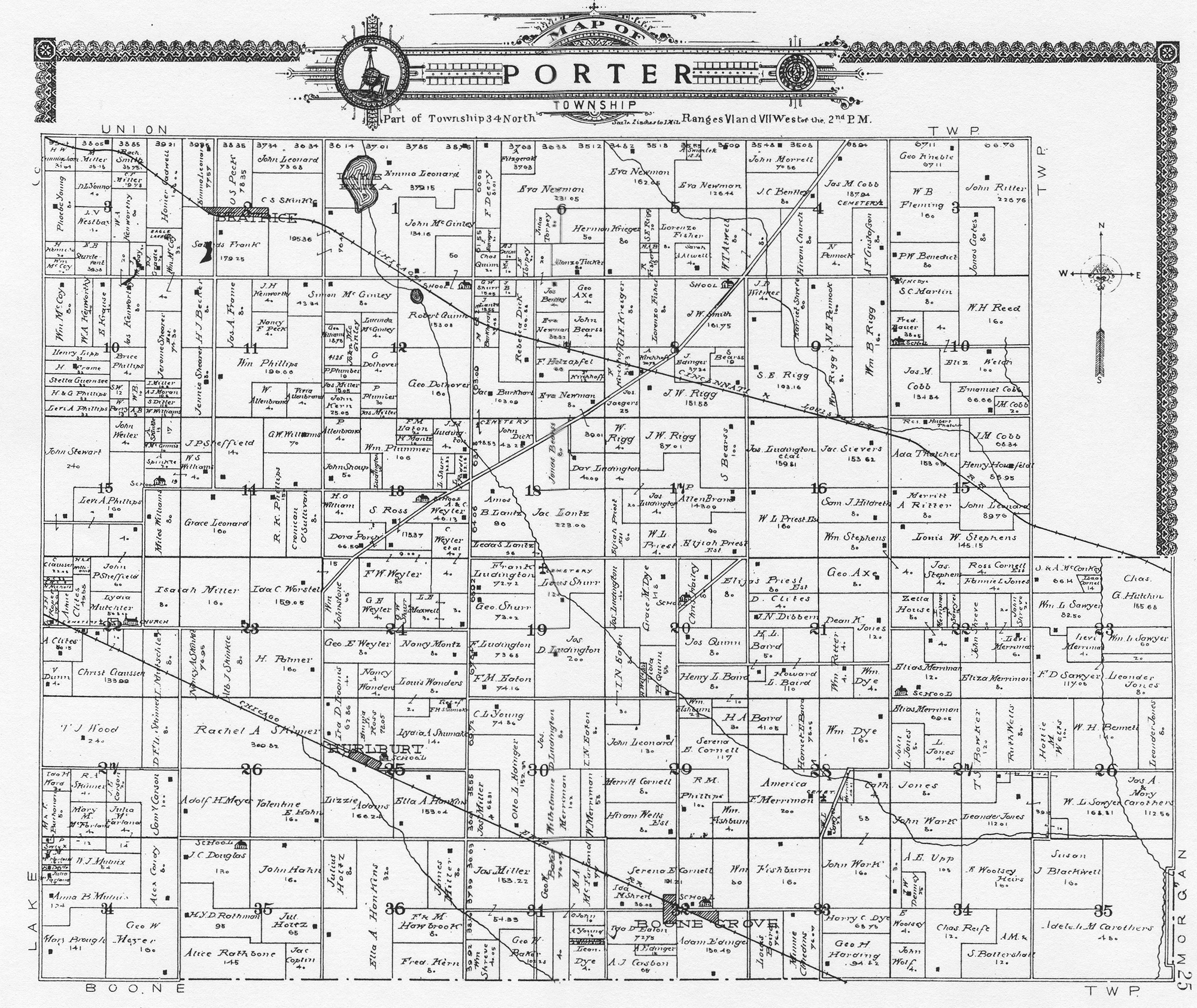
This 1906 map shows the location of the Hankins farm, where the illegal hunting took place, near the town of Hurlburt. It also shows the location of Amos’ farm near Boone Grove.

Hurlburt detail mapDetail of 1906 plat map, Porter Township, Porter County, Indiana.[4] (Click on image to enlarge)

Hurlburt was little more than a post office and a train depot. In 1910 it had a population of over 100.[5]

As a side note, the Hankins farm was established in 1882 by Albert Hankins.[6] He owned a gambling house in Chicago and raised racing horses at his farm in Porter County. He died in 1897 in a bizarre manner, as described in the Westchester Tribune:  [7]

DEATH BY STRANGULATION.
Albert Hankins Suffocates Before His Body is Extricated From The Folding Bed. Woman Who Could Have Saved Him Delays in Giving the Alarm and Mysteriously Disappears From The Scene
— Career of the Noted Gambler
“Farmer” Al Hankins, race horse man, speculator, philosopher, was a victim of the treacherous folding bed, having been smothered to death Wednesday afternoon, Aug. 25, at 1 o’clock in a room in the rear of his gambling place, 3908 Cottage Grove avenue, Chicago.
The sole witness of the accident, the only person who could, by timely warning, have prevented its fatal termination was a woman who rather than risk a confession of her identity, delayed in giving an alarm and mysteriously disappeared from the scene. The personality of the woman is shrouded behind a cloak of doubt and shielded by the care of a few who know who she is, and are familiar with the circumstances which brought here [sic?] within the scope of the tragedy.

You can read an extended version of this dramatic story and a summary of “Al” Hankins’ life in this Chicago Tribune article of August 26, 1897. This lovely illustration of his farm comes from the 1882 book, Counties of Porter and Lake, Indiana.[8]

Hankins farm Porter twp
(Click on image to enlarge)

I hope my readers will forgive this slight detour from the original subject of this post. Sometimes one interesting story leads to another. Genealogists refer to these as “BSOs” – bright shiny objects!

I’ll have more to say about Amos in the future. I was happy to see, as I’m sure are his descendants, that he did the right thing and refused the bribe.

[1] “Chicago Hunters Arrested,” The Lake County Times (Hammond, Indiana), 21 Aug 1913, p. 1, col. 3; image, Library of Congress, Chronicling America (http://chroniclingamerica.loc.gov : accessed 1 Mar 2017).
[2] “New York Passenger Lists, 1820-1891”, browsable images, FamilySearch (https://familysearch.org/ark:/61903/3:1:939V-51S2-X5?i=106&cc=1849782 : accessed 10 November 2016), image 107 of 341, line 27, James Custon; citing NARA microfilm publication M237.
[3] “Indiana Marriages, 1811-2007”, databased with images, FamilySearch (https://familysearch.org/ark:/61903/1:1:KDHQ-DK8 : accessed 16 February 2016), Amos J Casbon & Carrie B Aylesworth, 28 Nov 1900; citing citing Porter, Indiana, county clerk office; FHL microfilm 1,686,211.
[4] “Map of Porter Township”(N.p., n.p., 1906), image, Porter County, Indiana (http://www.inportercounty.org/Data/Maps/1906Plats/Porter-1906.jpg : accessed 2 March 2017).
[5] History of Porter County, Indiana: A Narrative Account of its Historical Progress, its People and its Principal Interests (Chicago: Lewis Publishing Company, 1912), vol 1, p.172.
[6] Weston A.Goodspeed & Charles Blanchard, Counties of Porter and Lake, Indiana: Historical and Biographical, Illustrated (Chicago, Illinois: F. A. Battey & Company, 1882), 383.
[7] “Death by Strangulation,” The (Porter, Indiana) Westchester Tribune, 4 Sep 1897, p. 1, col. 1; transcription, “Albert Hankins, Obituary/Death Notice,” Porter County, Indiana (http://www.inportercounty.org/Data/Obits/Hankins2558.html : accessed 2 March 2017).
[8] Goodspeed & Blanchard, Counties of Porter and Lake, Indiana, 135.

Why Indiana?

In a previous post I asked why Thomas Casbon left Ohio for Indiana. It seems that he was making a good go of things in Ohio. He owned his own farm. He raised his children to adulthood there. We’ll probably never know exactly why he decided to move, but it’s likely there was more than one reason.

Casbon Ohio to Indiana map
Thomas Casbon migrated from Holmes County, Ohio, to Porter County, Indiana. Source: Johnston, K. “United States of North America, eastern states.” Engraved & printed by W. & A.K. Johnston, Edinburgh. William Blackwood & Sons, Edinburgh & London,(1861) David Rumsey Historical Map Collection http://www.davidrumsey.com/ (Click on image to enlarge)

First, two of Thomas’ sons, Sylvester and Charles, had already moved to Porter County in 1859 and 1862, respectively. Here is a description of Sylvester’s move, from The History of Porter County:

Then acting under the persuasion of a friend Mr. Ellsworth, who had settled in Porter county, Indiana, and also from his own wish to locate further west, Mr. Casbon came to this county in 1859 and began teaching in what was then known as the Ellsworth school, which he conducted successfully for three terms. He also taught one term in Boone Grove and one term in the House school, as it was called then, but later known as Boone Grove school. [1]

“Ellsworth” in the preceding paragraph is a probably a misspelling of Aylesworth. The Aylesworth family history is intimately tied with that of the Casbons. When Thomas and family arrived in Wayne County, Ohio, two brothers, Ira and Philip Aylesworth, were already living there with their extended families. [2]  In addition, another one of their brothers, Giles Aylesworth, had moved from Wayne County, Ohio, to Porter County, Indiana in 1842. [3] Another Ira Aylesworth, Philip Aylesworth’s son, moved to Porter County in 1845. [4] It’s unclear which “Mr. Ellsworth” (Aylesworth) influenced Sylvester to come to Porter County. I think it was probably either Elias or Sylvenus Aylesworth, grandsons of Philip Aylesworth. [5] They were both born in Ohio and were contemporaries of Sylvester Casbon. At some point they moved to Boone Township in Porter County, and were both living there in 1860. [6]

I should also point out that Sylvester married Mary Adeline Aylesworth, daughter of Giles, in Porter County.

Charles Casbon’s biography in The History of Porter County suggests that he was influenced to move westward by the New York Herald (mislabeled as Tribune in the biography), whose famous editor, Horace Greeley, frequently exhorted his readers to “Go west, young man, and grow up with the country.”

It was partly with the inspiration derived from the Tribune, and also from the spirit of pioneering which had possessed his father before him, that caused Charles Casbon on arriving at his majority to start for the west. In company with a friend, George Bittner, in March, 1862, he arrived at Valparaiso, a small place at that time, where he paused in his journey and in this vicinity has remained ever since, to his own profit and to the benefit of the community. [7]

There is one problem with this version of events: Horace Greeley did not use the phrase “Go West, young man…” until 1865, [8] well after Charles left for Indiana! However, the statement that he went with his friend, George Bittner, sounds reasonable. An entry for George Bitner, born about 1844, is listed in the 1860 census for Washington Township, Holmes County, Ohio, [9] just five entries away from the listing for Thomas Casbon. This means they would have been neighbors. Assuming this is the George Bittner who accompanied Charles Casbon, he must not have stayed in Indiana, since he is listed in Holmes County, Ohio in later censuses, [10] and died in adjacent Wayne County in 1927. [11]

Not only did Sylvester and Charles move from Ohio to Indiana, but their older sister Mary Anne married Elijah Priest in 1853, [12] and moved to Porter County sometime after 1860, when the census recorded them living in Holmes County, Ohio. [13]

The fact that three of his children were in Indiana was probably a major reason that Thomas decided to make the move himself.

In addition to his children, many others were migrating from Ohio to Indiana. Some of the earliest settlers of Porter County came there from Wayne County, Ohio in the early 1830s. [14]  A fairly steady stream of residents migrated from Wayne and Holmes Counties through the 1860s. [15],[16]

Ohio to Indiana migrations
A partial list of individuals who migrated from Wayne & Holmes counties, Ohio, to Porter County, Indiana (Click on image to enlarge)

There were probably many factors behind this migration, foremost being the availability of cheap fertile land. As the population grew, it was easier to move west where there was abundant land instead of dividing already cultivated areas into smaller and smaller plots. This might have been a factor behind Thomas’ move as well.

A final factor in his decision to leave Ohio might have been the fact that Thomas’ brother in law James Scruby died in 1852, [17] and James’ wife Phebe died in 1851. [18] With their deaths Thomas and Emma no longer had family connections in the immediate area.

With his children’s relocation to northwest Indiana, the ongoing migration of other local families to the same area, and the loss of Emma’s family connections in Ohio, Thomas’ desire to move must have been compelling.

[1] “History of Porter County, Indiana: A Narrative Account of Its Historical Progress, Its People and Its Principal Interests,” Volume 2, pp 482-3. Lewis Publishing Company, 1912. Google Books https://books.google.com/books/about/History_of_Porter_County_Indiana.html?id=Nk00AQAAMAAJ [accessed 28 October 2016]
[2] “United States Census, 1840.” FamilySearch https://familysearch.org/ark:/61903/1:1:XHRJ-B3X [accessed 28 October 2016]
[3] “Aylesworth Family Of Porter County.” 1976. A Biographical History of Porter County, Indiana. Valparaiso, Indiana: American Revolution Bicentennial Committee of Porter County, Inc. Porter County, Indiana http://www.inportercounty.org/Data/Biographies/Aylesworth45.html [accessed 28 October 2016]
[4] [4] “Aylesworth Family Of Porter County.” 1976
[5] “The Aylesworth Family of Porter County Indiana…Eighth Generation” Aylesworth.net http://www.aylesworth.net/Confidence_family_DWT_CSS/Porter/porter_8.html [accessed 28 October 2016]
[6] “Unites States Census, 1860.” FamilySearch https://familysearch.org/ark:/61903/3:1:33SQ-GB9J-SZ6V?i=2&wc=QZ2C-XBP%3A1589426070%2C1589426630%2C1589423434%3Fcc%3D1473181&cc=1473181 [accessed 28 October 2016]
[7] “History of Porter County, Indiana…” Volume 2, pp 459-61.
[8] “Go West, Young Man, Go West. ” Dictionary of American History. Encyclopedia.com. http://www.encyclopedia.com [accessed 28 October 2016]
[9] “United States Census, 1860” FamilySearch https://familysearch.org/ark:/61903/1:1:MCG3-1SN[accessed 29 October 2016]
[10] “United States Census, 1880.” FamilySearch https://familysearch.org/ark:/61903/1:1:M89H-FTK [accessed 29 October 2016]
[11] “Ohio Deaths, 1908-1953.” FamilySearch https://familysearch.org/ark:/61903/1:1:X82N-2XF [accessed 29 October 2016]
[12] “Ohio, Marriages, 1800-1958.” FamilySearch https://familysearch.org/ark:/61903/1:1:XDK9-L58 [accessed 21 July 2016]
[13] “United States Census, 1860” FamilySearch https://familysearch.org/ark:/61903/1:1:MCGS-MZ2 [accessed 28 October 2016]
[14] Goodspeed, W.A.;Blanchard, C. 1882. Counties of Porter and Lake, Indiana: Historical and Biographical, Illustrated. pp. 17, 177, 332, 380-2. Chicago, Illinois: F. A. Battey & Company. Internet Archive https://archive.org/details/countiesofporter00good [accessed 28 October 2016]
[15] Goodspeed, W.A.;Blanchard, C. 1882. Counties of Porter and Lake, Indiana.
[16] “History of Porter County, Indiana…”
[17] “Rutherford B. Hayes Presidential Center Obituary Index.” Rutherford B. Hayes Presidential Center http://index.rbhayes.org/hayes/index/record_detail.asp?id=2304084 [accessed 16 Aug 2016]
[18] “Rutherford B. Hayes Presidential Center Obituary Index.” Rutherford B. Hayes Presidential Center http://index.rbhayes.org/hayes/index/record_detail.asp?id=2304086 [accessed 16 Aug 2016]