Five Families, Eleven Weddings

Slocum … I’ve heard that name before; I wonder if she’s related?

Today’s post is an outgrowth of the two previous posts, in which I explored the connections between the Casbon and Aylesworth family trees. While conducting my Aylesworth research, I came upon the name of Martha Slocum, who married Philip Aylesworth, a member of the fourth generation of his family in America and a direct ancestor of many living Casbons.

The name Slocum was not new to me. William Wallace Slocum married Mary Casbon in Ohio, 1862.[1] After Mary died, he married Emma Payne in 1865 (see “From England to America, Part 8”).[2] Mary Casbon was the niece of Thomas Casbon, the original immigrant from England, and Emma Payne was the niece of Thomas’s wife, Emma Scruby. Emma Payne’s mother, Sarah Scruby, was married to James Payne of Meldreth, Cambridgeshire, England.

A little digging showed that Martha and William Wallace Slocum were distantly related. They were both descended from Giles Slocum ( ? –1682), who immigrated from England to Rhode Island before 1648.[3] Martha was descended from Giles’s son Samuel and William Wallace from Giles’s son Eleazar. Martha was in the fifth generation of descendants and William Wallace in the seventh.

So now I knew that the Slocum, Aylesworth, and Casbon families were all related to one another.

Furthermore, with William Wallace Slocum’s marriage to Emma Payne, the Slocums became connected to the Scruby family, who were already related to the Casbons through the marriage of Emma Scruby to Thomas Casbon and later through the marriage of Mary Payne (Emma Payne’s sister) to James Casbon.

Are you confused yet?

I decided to plot out all the ways that the Slocum, Aylesworth, Scruby (including Payne), and Casbon families were related. I added a fifth family, Priest, because I was aware of multiple connections on their part as well. Here is the result of my efforts.

5 family connections cropped
Diagram depicting interconnected family trees of the Slocum (green), Aylesworth (orange), Scruby (pink), Casbon (blue) and Priest (yellow) families. Superscript numbers denote generations, with “1” depicting either the original immigrant (Slocum and Aylesworth) or the common ancestor (Scruby, Casbon, and Priest); colored lines indicate parent-child relationships and arrows depict direct descent through multiple generations; marriages are connected by black lines (Click on image to enlarge)

You’ll need to enlarge the diagram to see details.

As the title suggests, these five families are connected to each other through eleven marriages. Here is a summary of the connections for each family:

  • Slocum:
    – Connected to Aylesworth through the marriage of Martha5 Slocum to Philip4 Aylesworth, 1762[4]
    – Connected to Casbon through the marriage of William Wallace7 Slocum to Mary3 Casbon, 1862
    – Connected to Scruby through the marriage of William Wallace7 Slocum to Emma3 Payne, 1865
  • Aylesworth:
    – Connected to Slocum through the marriage of Philip4 Aylesworth to Martha5 Slocum, as above
    – Connected to Casbon through the marriages of Mary Adaline7 Aylesworth to Sylvester3 Casbon, 1860,[5] and Carrie Belle9 Aylesworth to Amos3 Casbon, 1900[6]
    – Connected to Scruby through the marriage of Louisa8 Aylesworth to George3 Scruby, 1872[7]
    – Connected to Priest through the marriage of Elliot7 Aylesworth to Caroline2 Priest, 1848[8]
  • Scruby:
    – Connected to Slocum through the marriage of Emma3 Payne to William Wallace7 Slocum, as above
    – Connected to Aylesworth through the marriage of George3 Scruby to Louisa8 Aylesworth, as above
    – Connected to Casbon through the marriages of Emma2 Scruby to Thomas2 Casbon, 1830,[9] and Mary3 Payne to James2 Casbon, 1876[10]
    – Connected to Priest through the marriage of James2 Scruby to Phebe2 Priest, 1824[11]
  • Casbon:
    – Connected to Slocum through the marriage of Mary3 Casbon to William Wallace7 Slocum, as above
    – Connected to Aylesworth through the marriages of Sylvester3 Casbon to Mary Adaline7 Aylesworth and Amos3 Casbon to Carrie Belle9 Aylesworth, as above
    – Connected to Scruby through the marriages of Thomas2 Casbon to Emma2 Scruby and James2 Casbon to Mary3 Payne, as above
    – Connected to Priest through the marriage of Mary Ann3 Casbon to Elijah2 Priest, 1853[12]
  • Priest:
    – Connected to Aylesworth through the marriage of Caroline2 Priest to Elliot7 Aylesworth, as above
    – Connected to Scruby through the marriage of Phebe2 Priest to James2 Scruby
    – Connected to Casbon through the marriage of Elijah2 Priest to Mary Ann3 Casbon, as above

Three of the families—Aylesworth, Scruby, and Casbon—are connected by marriage to all four of the remaining families. The remaining two families—Slocum and Priest—are connected to three of the other four families. Of the marriages, one took place in England, one in Rhode Island, six in Ohio, and three in Indiana.

The chart shows how entangled family trees can become. I’m going to coin a new term for this. Instead of a family tree, this is a family hedge! It’s an accurate description of what we see, with branches from several families intermingling and creating complex relationships.

I suspect this occurs more often than we might realize, but we might not see it because we’re not looking for it. Have you discovered any hedges in your family history?

[1] Ohio, Huron County, Marriage Records, vol. 1 [1855–1866], p. 350; imaged as “Ohio, County Marriages, 1789–2013,” FamilySearch (https://familysearch.org/ark:/61903/1:1:XZ65-99 : accessed 21 Jul 2016) >Huron >Marriage Records 1855–1866 vol 1 >image 220 of 306.
[2] Ohio, Huron County, Marriage Records, vol. 1 [1855–1866], p. 465, no. 2779; imaged as “Ohio, County Marriages, 1789–2013,” FamilySearch (https://familysearch.org/ark:/61903/1:1:XZ65-99 : accessed 22 May 2018) >Huron >Marriage Records 1855–1866 vol 1 >image 277 of 306.
[3] “Giles Slocum (abt. 1623 – aft. 1683),” article, WikiTree (https://www.wikitree.com/wiki/Slocum-10 : accessed 9 Apr 2020).
[4] James Newell Arnold, Rhode Island Vital Extracts, 1636–1850, volume 1 (Providence, R.I.: Narragansett Historical Publishing Company, 1891), p. 4; imaged at Ancestry (https://www.ancestry.com/search/collections/3897/ : accessed 2 Apr 2020) >Vol· 01: Kent County: Births, Marriages, Deaths >image 432 of 637.
[5] Indiana, Porter County, Marriage Record Book 2 [Dec. 1850–Jun. 186], p. 458; Valparaiso (Indiana) Public Library.
[6] Indiana, Porter County, Marriage Record, vol. 12 [Nov. 1898–Oct. 1901], p. 326; browsable images, FamilySearch (https://www.familysearch.org/search/film/005014498?cat=608739 : accessed 8 Apr 2020) > Film # 005014497 >image 548 of 922.
[7] Ohio, Holmes County, Marriage Record, vol. 5 [1868–1877], p. 217; browsable images, FamilySearch (https://www.familysearch.org/search/film/004024929?cat=229343 : accessed 8 Apr 2020) > Ohio, County Marriages, 1789-2013 >Holmes >Marriage records 1868-1877 vol 5 >image 491 of 649.
[8] Ohio, Wayne County, Marriage Record, vol. 4B [1843–1851], p. 377; browsable images, FamilySearch (https://www.familysearch.org/search/film/004260649?cat=335541 : accessed 26 Aug 2016) >Film # 004260649 >image 550 of 644.
[9] Church of England, Melbourn (Cambridgeshire), Marriages, 1813–1837, p. 59, no. 175; browsable images, ” FamilySearch (https://www.familysearch.org/search/film/007549343?cat=210722 : accessed 5 Feb. 2019) >image 318 of 710.
[10] Indiana, Porter County, Marriage Record, vol. 4 [Sep. 1871–Jan. 1875], p. 348; browsable images, FamilySearch (https://www.familysearch.org/search/film/005014495?cat=608739 : accessed 8 Apr 2020) > Film # 005014494 >image 693 of 928.
[11] Ohio, Wayne County, Marriage Record, vol. 4A [1835–1843], p. 91; browsable images, FamilySearch (https://www.familysearch.org/search/film/004260649?cat=335541 : accessed 8 Apr 2020) >Film # 004260649 >image 77 of 644.
[12] Ohio, Wayne County, Marriage Record, vol. 4 (1-2) [1844–1856], p. 140; FamilySearch (https://www.familysearch.org/search/film/004260672?cat=335541 : accessed 8 Apr 2020) > Film # 004260672 >image 97 of 720.

A Visit to Ohio

aha moment
noun informal.
1. a point in time, event, or experience when one has a sudden insight or realization.[1]

Most of the time, genealogy research is fairly routine. You ask a question—“when was so-and-so born?”—and look for records that might answer the question. You either find the answer or you don’t, and then you move on. What can make it fun is when you have that “aha” moment—when the answer to a question pops up quite unexpectedly. Has this ever happened to you?

I had such a moment last year when I was browsing through old newspaper articles on microfilm in the Valparaiso (Porter County , Indiana) Public Library. I found this in the Porter County Vidette of 27 August 1891.

Mary P Casbon visit Rachel Slocum PCV 27Aug1891
Untitled news item, Porter County Vidette, 27 August 1891

This single sentence answered not one but two questions that I had all but given up on finding the answers to. The questions were:

  1. Was Mary Payne, who married James Casbon in 1876, the same Mary Payne who arrived in Ohio from England with Mary Casbon in 1856?
  2. Was William Scruby who lived in Porter County, Indiana in the late 1800s, the son of James Scruby of Wooster, Ohio?

After finding this article, it was clear to me that the answer to both questions was yes!

Some background information will help you see how I came to these conclusions. Accordingly, let me introduce a brief cast of characters:

Emma Scruby (1811–1870): the wife of Thomas Casbon (1803–1888)

Emma or Rachel Payne (b. 1830): a niece of Emma (Scruby) Casbon; daughter of Emma’s sister Sarah (Scruby) Payne

Mary Payne (b. 1832 or 33): another niece of Emma (Scruby) Casbon; sister of Emma/Rachel Payne

William Scruby (b. abt. 1837): a nephew of Emma (Scruby) Casbon; son of Emma’s brother, James Scruby; also a first cousin of Emma/Rachel and Mary Payne

James Casbon (1813–1884), the brother of Thomas Casbon

The Scruby family plays an important role in the story of the Casbon family in the United States. When Thomas and Emma (Scruby) Casbon migrated from England to Ohio in 1846, they were greeted by Emma’s older brother James Scruby, who left England in 1832 and settled near Wooster, Wayne County, Ohio. Thomas and Emma lived and raised their family in Ohio, initially in Wayne County, and later, a few miles south in Holmes County. James undoubtedly influenced their decision to emigrate and helped them to get settled.

In addition to their own family, Thomas and Emma brought Emma’s niece “Rachell [sic] or Emma Payne” with them from England. Two names are given for this niece because she is referred to in various records by either of these names and is also recorded as “Emma R. Payne.”

Ten years after the arrival of Thomas and Emma Casbon, Emma/Rachel’s sister, Mary Payne migrated from England to Ohio, along with Thomas Casbon’s niece, Mary Casbon, who was the daughter of Thomas’s deceased brother, Joseph. This story is told in a handwritten family history.

Mary Payne etc
Detail from an untitled manuscript, author unknown, ca. 1890-92, describing Isaac Casbon
and the descendants of his son Thomas; note the term “Rachell or Emma Payne”

Mary Payne & Rachell or Emma Payne
came to America & They were the
daughters of Sarah Scruby sister to
Emma wife of Thomas Casbon
Mary Payne came to America in
the year 1856 Mary Casbon daughter of
Joseph Casbon who was a brother of
Thomas Casbon came to America with
Mary Payne Emma came with the
Family of Thomas Casbon to America

The story gets convoluted at this point. Mary Casbon, Thomas’s niece, married William Wallace Slocum in 1862.[2] Mary evidently died within a few years. Mr. Slocum next married Emma R. Payne on 23 March 1865.[3] In addition to the official marriage records, we find this part of the story published in a history of the Slocum family.

Mary Casbon Emma Payne in William Slocum genealogy
Detail from Charles Elihu Slocum, M.D., Ph.D., LL.D., History of the Slocums, Slocumbs and Slocombs of America
(Defiance, Ohio: privately published, 1908), vol. 2:129; the peculiar spelling is due to the fact that the
author was an adherent of a movement to simplify spellings in the English language.

We know from the description of her birthplace and voyage to America that Mr. Slocum’s third wife was same woman who emigrated to America with Thomas and Emma Casbon.

Through her marriage Emma/Rachel became the “Mrs. Rachel Slocum” referred to in the 1891 news brief. We can place Emma/Rachel in Shiloh, Ohio, because that is where her husband died in 1888.

But what of her sister Mary? Although she arrived in Ohio in 1856, Mary does not appear in the 1860 or 1870 censuses and I haven’t been able to find any trace of her during this time frame.

Enter, stage left, James Casbon. In 1870, James emigrated from England to Indiana, where his brother Thomas had been living since 1865. James married a woman named Mary Payne at Porter County, Indiana, in 1876, following the death of his wife Mary neé Jackson.

James C Mary P marriage
The marriage record of James Casbon and Mary Payne, Porter County, Indiana, 15 January 1876;
“Indiana Marriages, 1811–2007” (FamilySearch); citing Porter County Marriage Records, vol. 4:348
(Click on image to enlarge)

Was James Casbon’s wife the sister of Emma/Rachel Slocum? I thought she might be but did not have enough evidence to prove the relationship. James and Mary appear together in the 1880 U.S. census in Porter County. Her age was reported as 53, which would give her a birth year of about 1827—about five years earlier than expected for Emma/Rachel’s sister. Her birthplace was reported as England, so at least that fact fit the theory.

The question remained unresolved for several years until my “aha” moment arrived last year. “Mrs. James Casborn [sic]” was going to visit her sister, “Mrs. Rachel Slocum,” in Shilo [sic] O[hio]. Quod Erat Demonstrandum! The missing link was found!

There is still a lot of missing information. Where was Mary Payne between 1856 and 1876? When did she move to Indiana? What circumstances led to her marriage to James Casbon? My guess is that she either followed her aunt Emma and uncle Thomas Casbon to Indiana, or that she came with William Scruby, who was her cousin. Although it is common for relatives to remain in proximity to one another, it is still intriguing to me that the paths of Emma and Thomas Casbon, James Casbon, William Scruby, and Mary Payne intersected in so many places and points in time.

But what of William Scruby? He has had only had a minor role in today’s story. His story will be next.

[1] “aha moment,” Dictionary.com (https://www.dictionary.com/browse/aha-moment )
[2] “Ohio, County Marriages, 1789-2013 ” (FamilySearch) )>Huron >Marriage Records 1855-1866 vol 1 >image 220 of 306; citing Huron County.
[3] “Ohio, County Marriages, 1789-2013 ” (FamilySearch) )>Huron >Marriage Records 1855-1866 vol 1 >image 277 of 306; citing Huron County.

Musings on John

This is a follow-on to an earlier post titled “Stuck on John,”  in which I described how my research into the origins of the Meldreth branch of the Casbon family hit a “brick wall.” I had been able to trace the ancestry to a John Casborn who married Anne Chamberlain in 1742.[1] The problem was that there were at least two men named John Casb—— living in or near Meldreth at the time, and there wasn’t enough information to know for certain which one was the husband of Anne. But now, I’ve discovered evidence that puts me on much firmer ground about who “my” John might be.

First, let’s review what I know about my ancestor John. After their marriage, John and Anne had five children, according to baptismal records: Thomas (my ancestor, baptized in 1743), James (1747, buried 1748), James (1748), Mary (1750), and Anna (1754).[2] Anne, John’s wife, died in 1770.[3] John was described as “parish clerk” when he was buried in 1796.[4]

Casb John bu 1796 Meldreth Detail of burial record, 1796, from Meldreth Parish registers. “John Casborn, Parish Clerk, aged 75. January 4.”
(Click on image to enlarge)

We can be reasonably sure that all of these records refer to the same man because there are no other men named John Casb—— recorded in the parish records of Meldreth and its vicinity during this time frame. Since the burial record gives his age as seventy-five, we can extrapolate a birth year of 1720 or 1721. This is very helpful.

The only person I have found who matches all of this information is John Casborn, the son of Thomas and Mary (Jeap), who was baptized in the village of Orwell, about two and one-half miles from Meldreth, in November 1721.[5]

Casborn John bp Orwell 1721
Detail of baptism record, 1721, Orwell Parish registers, 1560-1877. “Nov. 26 John y[e] Son of
Thomas & Mary Casborn.” (Click on image to enlarge)


Map of southwestern Cambridgeshire, showing villages of Orwell and Meldreth.
(Google Maps – zoom in for greater detail

Notably, aside from his baptism, John does not appear again in Orwell parish records. This suggests that he moved elsewhere before his marriage and/or burial. How can we know if he is the same man who moved to Meldreth and later married Anne?

Here’s where the new evidence comes in, in the form of registers of duties paid for apprentices’ indentures. When a master took on (i.e., indentured) a new apprentice, he was paid a fee, usually by the parents of the apprentice. The master was required to pay a tax, or duty, on this fee. Records of apprenticeships, fees and duties were created by the Board of Stamps, and are now maintained by The National Archives of the UK.[6] These records can be searched at Ancestry.com.

I found this record in the collection (you’ll need to click to be able to read it).

Merged 1736 apprent duties
Detail from Register of Duties Paid for Apprentices Indentures, 9–12 July 1736.[7] (Click on image to enlarge)

This record shows that “Will. Casbill of Mildred in Cambridge Cordwr. [cordwainer]” received a fee of four pounds, eleven shillings for the indenture of “John Casbill of Orwell” for a duration of four years, nine months, beginning “24 June last.” William Casbill was required to pay a duty of two shillings, three and one-half pence, based on the indenture fee.

The record is important because it connects John of Orwell to the village of Meldreth. He would have been about fifteen years old in 1736, an appropriate age for an apprentice. It’s odd that the term of indenture is only four years, nine months, since the usual apprenticeship was for seven years. It makes me wonder if William had been training John “off the books” for a couple of years before he paid the tax.

Who was his master, William Casbill? I don’t know for certain. One candidate is William Casbel, who was born in Meldreth in 1703 and was orphaned when his mother died in 1718.[8] Another candidate is John’s paternal uncle, William Casbolt, baptized 1695 in nearby Barrington. There are burial records for William Casbel in 1741 and William Carsburn in 1756.[9] Unfortunately, neither of these provide information about the deceased’s ages or occupations.

Incidentally, cordwainer is the old term for a shoemaker. There seems to have been a succession of cordwainers from Meldreth named Casb——. I wrote previously about John Casball, cordwainer, who paid duties for an apprentice in 1718 and died in 1727 (“a poor shoemaker”). He was followed by William of the 1736 indenture, who was followed by John of Orwell. Given the surname, it’s hard to believe these men weren’t all related in some way. It seems likely that the earlier John trained William to be a cordwainer, although I haven’t found any such records.

Getting back to John of Orwell, another apprenticeship record shows us that he remained in Meldreth as a master cordwainer following completion of his own apprenticeship.

merged 1774 apprent duties
Detail from Register of Duties Paid for Apprentices Indentures, 24–28 January 1774.[10] (Click on image to enlarge)

This record shows that on January 28, 1774 “John Casbon of Meldreth in Co. of Cambridge Cordwainer” paid the indenture duty for an apprentice named Thomas Wing.

Thus, we have several points that can be connected to describe John’s life from his baptism in Orwell to his burial in Meldreth. Using the available records we can create this chronology:

  • 1721: John Casborn, son of Thomas and Mary (Jeap), is baptized in Orwell
  • 1736: John Casbill of Orwell is indentured as an apprentice to William Casbill of Meldreth
  • 1742: “John Casborn of the Parish of Meldreth and Ann Chamberlain of this Parish” are married in Wimpole, Cambridgeshire, 18 January 1742
  • 1743–1754: five children are born to John & Ann, including Thomas (baptized 1743)
  • 1770: “Anne Casbull Wife of John Casbill” is buried at Meldreth
  • 1774: John Casbon, cordwainer, indentures Thomas Wing as apprentice
  • 1796: “John Casborn, Parish Clerk, aged 75” is buried at Meldreth

You may notice an inconsistency in this chronology. The burial record of 1796 describes John as the parish clerk, but not as a cordwainer. Could he have been both parish clerk and cordwainer? I believe the answer is yes. I’ll address this in the next post.

Considering all the evidence, I’m confident that this “brick wall” is gone, i.e., I believe John Casborn, baptized 1721 in Orwell, is my direct ancestor and the common ancestor for all the Casbons, Casbans and Casbens who descended from his children. What do you think?

As an epilogue to John’s story, we find that in 1797, Thomas Wing, John’s former apprentice and now a master cordwainer himself in Meldreth, indentured an apprentice of his own.[11] The torch was passed.

[1] Church of England. Wimpole Parish (Cambridgeshire, England), Bishop’s transcripts for Wimpole, 1599-1857, Casborn–Chamberlain marriage (1742); digital images, FamilySearch (https://familysearch.org/ark:/61903/3:1:3QS7-89PH-H6G9?i=121&cat=1317069 : accessed 7 June 2016), image 122 of 799.
[2] Church of England, Meldreth Parish registers; accessed as “Parish registers for Meldreth, 1681-1877, FamilySearch (https://www.familysearch.org/search/catalog/210742), images 109-111 of 699; citing FHL microfilm 1,040,542, item 2.
[3] Ibid, image 61 of 699.
[4] Ibid, image 129 of 699; citing FHL microfilm 1,040,542, item 3.
[5] Church of England, Parish of Orwell (Cambridgeshire), Parish Registers; accessed as “Parish Registers, 1560-1877,” browsable images, FamilySearch (https://www.familysearch.org/search/film/007567608?cat=210878 : accessed 26 December 2018), image 278 of 695; citing FHL microfilm 1,040,543, item 9.
[6] “Board of Stamps: Apprenticeship Books,” The National Archives (http://discovery.nationalarchives.gov.uk/details/r/C9339 : accessed 23 December 2018).
[7] “UK, Register of Duties Paid for Apprentices’ Indentures, 1710-1811,” database with images, Ancestry (https://search.ancestry.com/search/db.aspx?dbid=1851 : accessed 19 December 2018), 1735-1739 >image 339 of 909, 10 Jul 1736; citing The National Archives, IR-1/14, Kew.
[8] Church of England, Meldreth Parish registers; accessed as “Parish registers for Meldreth, 1681-1877, FamilySearch (https://www.familysearch.org/search/catalog/210742), images 48 & 101 of 699; citing FHL microfilm 1,040,542, item 2.
[9] Ibid., images 54 & 57 of 699.
[10] “UK, Register of Duties Paid for Apprentices’ Indentures, 1710-1811,” Ancestry (https://search.ancestry.com/search/db.aspx?dbid=1851 : accessed 10 May 2018), 1770-1774 >images 732-3 of 1930, 28 Jan 1774; citing The National Archives, IR1/28, Kew.
[11] “UK, Register of Duties Paid for Apprentices’ Indentures, 1710-1811,” Ancestry (https://search.ancestry.com/search/db.aspx?dbid=1851 : accessed 23 December 2018), 1794-1799 >imgs 424-5 of 1960, 20 Apr 1797; citing the National Archives, IR 1/ 68.

Going, Going …

The sister villages of Meldreth and Melbourn in Cambridgeshire are my ancestral homeland. Records of Casbon ancestors in these villages go back to the mid-sixteenth century. Families occasionally moved from one village to another, or to other nearby villages, but there was little reason or incentive to go further. The situation remained stable for over 250 years, but in the 1840s, things began to change.

Slowly at first, and then with increasing speed, the number of Casbons in Meldreth and Melbourn began to dwindle. In the 1841 census, there were 7 households with 30 people; in 1851, 7 households with 27 people; 1861 – 4 households/14 people; 1871 – 5 households/12 people; 1881 – 2 households/4 people; 1891 – 2 households/5 people; 1901 & 1911 – 1 household/2 people.[1] (1911 is the last year census records have been made available to the public.) The 1939 register (a census-like record taken before World War 2) shows only one Casbon living in Meldreth.

chart Chart showing decline in Casbon households and family members in Meldreth and Melbourn from 1841 to 1939. (Click on image to enlarge)

What happened? Where did they go and why did they leave? The reasons are varied, but for the most part revolve around the “three Fs”: finance, family, friends. In the mid-1800s, the growth of cities and improvements in transportation created new job opportunities. The exodus from Meldreth took off after the arrival of the railroad in 1851.[2]

1841
Casbon households in Meldreth, 1841 England Census.

The first to leave was my third great grandfather, Thomas (1803–1888), and his family, when they emigrated to the United States in 1846. I’ve written extensively about Thomas and his journey, so will not elaborate further here.

1851 Casbon households in Meldreth & Melbourn, 1851 England Census.

The next to go was James Casbon (1806–1871), who moved to the village of Barley in Hertfordshire with his family, probably in the early 1850s.[3] Barley is located about five miles south of Meldreth.

Barley map
Detail map showing Cambridge, Meldreth, Melbourn, and Barley.[4] (Click on image to enlarge)

James was a landowner, which put him in a different class than his poorer Casbon relatives. He also had a business as a carrier, hauling freight (and perhaps passengers) to and from London. His reasons for moving to Barley are unknown. His sons remained in Barley and established their own families there. Thus, Barley became a new population center for the Casbon surname.

Between 1851 and 1861 the number of Casbon households was further reduced due to deaths, employment, and unknown other reasons. Lydia (Burgess) Casbon, widow of Joseph (abt. 1811–1847), died in 1851.[5] Two daughters, Hannah and Harriet Ann, preceded her in death in 1848 and 1850, respectively, and a third daughter, Emma, died in 1852.[6] Lydia’s surviving daughter, Mary, emigrated to the United States, where she joined her uncle Thomas Casbon, in 1856.[7] “Patty” Barns (née Martha Wagstaff), widow of John Casbon (abt. 1779–1813), died in 1855.[8] After losing his wife, Elizabeth, in 1852, James Casbon (b. abt. 1813) and his family disappeared from view until he emigrated to Indiana in 1870.[9] Mary Ann Casbon (b. 1831, daughter of William, b. 1805), who had been working as a servant in Melbourn in 1851, was employed as a cook in a London public house by 1861.[10]

1861 Casbon households in Meldreth, 1861 England Census.

Although the numbers remained relatively stable between 1861 and 1871, some important moves still took place. Three more of William’s (b. 1805) children left for the environs of London: John (b. abt. 1842), Reuben (b. 1847) and Martha (b. abt. 1855). John was working as a Labourer when he was married in Lambeth (now a borough of London) in 1866.[11] Reuben must have moved to the London area in the same time frame, since he and his sister Mary Ann are listed as witnesses on the marriage record. Martha, perhaps following in her brothers’ footsteps, is listed as a sixteen-year-old “domestic servant housemaid” for a suburban London household in the 1871 census.[12]

1871 Casbon households in Meldreth & Melbourn, 1871 England Census.

The numbers plunged after 1871, as the “old-timers” – Jane (1803–1872), William (1805-1877) and William (1806–1875) died and their remaining children moved away. Samuel Clark Casbon (b. 1851) moved to Croydon, Surrey.[13] His sister, Jane, married John Camp in 1881.[14] Only the younger William (b. 1835), and John Casbon (b. 1849) remained. William’s three children, Walter (b. 1856), William (b. 1860), and Priscilla (b. 1862), all left home for jobs in domestic service or the railroads.

William (b. 1835) died in 1896. After his death, his wife, Sarah (West, b. abt 1823) moved to Hitchin, Hertfordshire, where she lived with her son, Walter, until her death in 1905.[15] John (b. 1849) died in 1935, followed by his wife Sarah (Pepper, b. abt 1850) in 1938.[16] John and Sarah were the only two Casbons on the 1901 and 1911 censuses for Meldreth.

Wm C b1835 grave marker 1896
The memorial stone of William (1835–1896) and Sarah (West, abt 1823–1905) Casbon, Holy Trinity Churchyard, Meldreth. “In/ Memory of/ WILLIAM CASBON/ who died March 7th 1896/aged 61 years/”We hope to meet again at/ The Resurrection of the just/A light is from the household gone/ A voice we loved is stilled/ A place is vacant in our home/ Which never can be filled”./ Also of /SARAH, wife of the above/who departed this life/ December 22nd 1905/ aged 83 years./She hath done what she could/ Her end was peace./”
Photograph by Malcolm Woods; Meldreth History website (http://www.meldrethhistory.org.uk).
(Click on image to enlarge)

Martha Casbon (b. abt. 1855), who spent most of her adult life in domestic service, returned to Meldreth in her later years, and is the sole Casbon listed on the 1939 register.[17] With her death in 1947, the Casbon name became extinct in Meldreth.[18]

[1] Data extracted from England censuses by Jon Casbon.
[2] Happy Birthday, Meldreth Station (no publication details available), leaflet; PDF download (http://meldrethsheprethfoxtonrail.org.uk/wp-content/uploads/2013/05/Meldreth150.pdf : accessed 1 November 2018).
[3] Jon Casbon, “James Casbon, Farmer and Carrier, 1806-1871, Part 1,” 23 Jan 17, Our Casbon Journey (https://casbonjourney.wordpress.com/2017/01/23/james-casbon-farmer-and-carrier-1806-1871-part-1/ : accessed 1 November 2018).
[4] Ordnance Survey of England and Wales (Southampton: Director General at the Ordnance Survey Office, 1903), Sheet 16; online image, A Vision of Britain Through Time (http://www.visionofbritain.org.uk/maps/sheet/new_series_revised_medium/sheet_16 : accessed 1 November 2018).
[5] England and Wales, “Search the GRO [General Register Office] Online Index,” database, HM Passport Office (https://www.gro.gov.uk/gro/content/certificates/indexes_search.asp : accessed 1 November 2018), Lydia Casbon, 2d qtr, 1851, Royston & Buntingford, vol. 6:405.
[6] Ibid., Hannah Casbon (age 5), 2d qtr, 1848, Royston & Buntingford, vol. 6/433. Ibid., Harriet Ann Casbon (age 11), 3d qtr, 1852, Royston & Buntingford, vol. 6/366. Ibid., Emma Casbon (age 7), 2d qtr, 1852, Royston & Buntingford, vol. 3A/131.
[7] Jon Casbon, “From England to Indiana, Part 8,” 18 Nov 2016, Our Casbon Journey (https://casbonjourney.wordpress.com/2016/11/18/from-england-to-indiana-part-8/ : accessed 1 November 2018).
[8] England and Wales, “Search the GRO [General Register Office] Online Index,” (cited previously), Martha Barnes, 4th qtr, 1855, Royston, vol. 3A: 128.
[9] Jon Casbon, “James Casbon of Meldreth, England and Porter County, Indiana,” 29 Nov 2016, Our Casbon Journey (https://casbonjourney.wordpress.com/2016/11/29/james-casbon-of-meldreth-england-and-porter-county-indiana/ : accessed 1 November 2018).
[10] 1861 England Census, Middlesex, Islington, population schedule, district 36, Johnston parish, p. 55 (stamped), schedule 153, Mary Ann Cusbin in household of Richd Munford; imaged on Ancestry (https://search.ancestry.com/search/db.aspx?dbid=8767 : accessed 1 November 2018), Middlesex >Islington >Islington East >District 36 >image 28 of 84; citing The National Archives, RG 9, piece 146, folio 55, p. 27.
[11] “London, England, Church of England Marriages and Banns, 1754-1921,” Ancestry (https://search.ancestry.com/search/db.aspx?dbid=1623 : accessed 22 March 2017), Lambeth >St. Mary, Lambeth >1761-1896 >image 337 of 540; citing London Metropolitan Archives, ref. no. p85/mry1/541.
[12] 1871 England Census, Kent, Lewisham, population schedule, enumeration district 4, schedule 214, Martha Casbon (indexed as “Carbor”} in household of John H Greeno; imaged on Ancestry (https://search.ancestry.com/search/db.aspx?dbid=7619 : accessed 19 March 2018), Kent >Lewisham >Lee >District 4 >image 62 of 80; citing The National Archives, RG 10, piece 763, folio 89, p. 61.
[13] 1881 England Census, Surrey, Croydon, population schedule, enumeration district 35, schedule 256, Samuel Casban; image on Ancestry (https://search.ancestry.com/search/db.aspx?dbid=7572 : accessed 1 November 2018), Surrey >Croydon >District 35 >image 49 of 66; citing The National Archives, RG 11, piece 816, folio 60, p. 47.
[14] “England and Wales Marriage Registration Index, 1837-2005”, database, FamilySearch (https://familysearch.org/ark:/61903/1:1:2DRB-92Y : accessed 1 November 2018), Jane Casbon, 1st qtr, 1881, Royston, vol. 3A/323.
[15] Kathryn Betts, “Holy Trinity Churchyard: Monumental Inscriptions.” Meldreth History (http://www.meldrethhistory.org.uk/page_id__484_img__4391.aspx : accessed 1 November 2018).
[16] “England and Wales Death Registration Index 1837-2007”, FamilySearch (https://familysearch.org/ark:/61903/1:1:QVHV-Q78D : accessed 1 November 2018), John J Casbon, 1st qtr, 1935, Cambridge, vol. 3B/564. Same source (https://familysearch.org/ark:/61903/1:1:QVHP-YBY9 : accessed 1 November 2018), Sarah Casbon, 1st qtr, 1938, Cambridge, vol. 3B/553.
[17] 1939 Register, South Cambridgeshire R.D., enumeration district TBKV, schedule 34, Martha Casbon; imaged on findmypast (https://search.findmypast.com/search-world-records/1939-register : accessed 19 November 2016); citing The National Archives, R39/6326/6326I/005/05.
[18] “England and Wales Death Registration Index 1837-2007”, FamilySearch (https://familysearch.org/ark:/61903/1:1:QVCQ-FH17 : accessed 2 August 2016), Martha Casbon, 1st qtr, 1947, Cambridge, vol. 4A/257.

Chatteris

CHATTERIS, a parish and market town in the hundred of North Witchford, in the county of Cambridge, 26 miles N.W. of Cambridge, and 7 S. of March. It is a station on the Ely and Peterborough railway, and is situated on the river Ouse. Alwina, wife of Athelstan, and niece of King Edgar, founded a convent of Benedictines about a.D. 980, which was in Henry VIII’s. reign wholly suppressed. The place is mentioned in Domesday Survey under the name of Cateriz, or Cetriz. Tho living is a vicarage in the diocese of Ely, val. £1,500, in the patron. of W. Hawkins, Esq. The church, dedicated to SS. Peter and Paul, is a handsome edifice. … The town was made a market town in 1834; and a court-leet and petty sessions are held here. The Bishop of Ely is lord of the manor. A large number of Roman coins and curious relics have been found at various times, and not many years since part of the skeleton of an elephant.[1]
OS map 16 1903 Detail from Ordnance Survey of England and Wales, Sheet 16, 1:253,440, 1903. Chatteris is near the top of the map. This work incorporates historical material provided by the Great Britain Historical GIS Project and the University of Portsmouth through their web site A Vision of Britain through Time (http://www.VisionofBritain.org.uk). (Click on image to enlarge)
context map
Partial map of England showing approximate area encompassed by detail map, above. Adapted from Google Maps (https://maps.google.com)

In my wanderings through various online archives, I discovered a number of Casbon entries from the parish of Chatteris. The name first appears in the 1851 census with an entry for Sarah Casbon, age 30, and her four children.[2] It turns out that this is a misspelling of their correct surname, Casburn, which appears in almost every other available record. The Casburn spelling is strongly associated with the parish of Burwell in Cambridgeshire. It turns out that Sarah’s husband, John Thomas Casburn, was born in Burwell.[3] He served as the butler to the principal landowner and member of Parliament for Chatteris.[4] I have not found any connection between the Casburns of Burwell and modern-day Casbons.

But then, the Casbon spelling pops up again in three separate entries in the 1881 England census.[5],[6],[7]

Lester 1881 composite Harriet 1881 detail
Emma Harry detail 1881
Details from 1881 England Census, Chatteris, Cambridgeshire. (Click on images to enlarge)

These 3 entries show respectively: Lester (misspelled) Casbon and his family; Harriet Casbon and her children, Rosa, Mary A, Harriet and Arthur, in the home of Ann Weaton; and Harry Casbon in the home of Emma Allpress. We can see that Lester is listed as the head of his household. Harriet is Ann Weaton’s daughter, and Harry is Emma Allpress’ grandson. It will take some backtracking to show how they are related.

It starts with a man named John Casbon, who married Emma Taylor in 1841.[8] John was a cordwainer, or shoemaker.[9] John and Emma had three children: Lester, born in 1842;[10] Sarah Ann, in 1844;[11] and John, in 1846.[12] Later census records tell us that all three children were born in Colne, Huntingdonshire (see map above). John, the father’s, death at age 30, was registered in 1848.[13] I haven’t found any record of John’s birth or birthplace, so the trail goes cold there.

After John’s death, Emma married a man named John Allpress.[14] The expanded family appears in the 1851 census, living in Somersham, Huntingdonshire (see map above).[15]

John Allpress 1851 census Somersham
Detail from 1851 census, Somersham, Huntingdonshire. (Click on image to enlarge)

Lester, Sarah Ann, and John are all shown with their surname spelled Casbey.

Sometime before 1861, John and Emma Allpress moved from Somersham to Chatteris.[16] Emma’s sons, Lester and John, raised their families and remained in Chatteris the rest of their lives. Daughter Sarah Ann is lost to follow up after 1861, although I have an intriguing theory about her fate (teaser for a future post!).

Lester married Julia Ann Mould, a Chatteris native, in 1871.[17] Lester and Julia had the following children:

Elizabeth Ann, born 29 Jan 1872[18]
Charles William, born 1 Sep 1873[19]
Emma, born 14 August 1873[20]
Alfred Lester, born 1880, died 1880[21],[22]

Lester and his entire family are seen in the 1881 census entry, above. Lester died in the Chatteris area in 1925; his wife Julia had died one year earlier.[23]

John married Harriet Davis, also a Chatteris native, in 1868.[24] They had the following children:

Rose Ann, born 1868[25]
Mary, born 1871[26]
Harriet, born 1874[26]
Arthur, born 1878[27]
Harry, born 1882[28]
William, born 1887[29]

John’s wife, Harriet, is seen in the 1881 census, above. John’s whereabouts in the 1881 census are unknown, but he is present with the rest of the family in subsequent censuses. John and his wife Harriet both died (probably) in 1931.[30],[31]

To the best of my knowledge, none of the male descendants had children of their own, so there are no living Casbon-surname descendants of this branch of the family. However, there are likely many descendants from Lester and John’s married daughters. My father corresponded with a descendant of Rose Ann (Casbon) Foster, 20+ years ago. If any descendants are reading this post, I hope they will contact me.

Since I haven’t been able to trace the origins of Lester and John’s father, I don’t know whether or how this branch of the Casbon-surname family is connected to other branches of the family. Burwell is a potential point of origin, considering that many records use the Casburn spelling. There is also a strong geographic connection to the Peterborough Casbons. Thomas Casbon (~1776–1855), was living about 5 miles from Chatteris in 1812, and was living in Colne, Huntingdonshire (where Lester, John, and Sarah Ann were born in the 1840s) in 1851.[32],[33] His son, Thomas (1807–1863), lived in Warboys, about 5 miles from Colne, in 1841, before moving to Peterborough.[34] His wife, Jane, was born in Chatteris.[35] DNA testing would be necessary to determine whether the Chatteris and Peterborough branches are related.

The observant reader will note that I have not discussed Harry Casbon, shown in the 1881 census, above, with his grandmother Emma (Casbon) Allpress. He is not the son of either Lester or John. Who does that leave? I will save his story for a future post.

[1] Adapted from: N.E.S.A. Hamilton, ed., The National Gazeteer of Great Britain and Ireland; or, Topographical Dictionary of the British Isles (London: James S. Virtue, 1868), vol. 3: 541; online image, Hathi Trust Digital Library (https://babel.hathitrust.org/cgi/pt?id=uiug.30112053400526;view=1up;seq=91 : accessed 28 January 2018).
[2] “1851 Census of England,” database with images, Ancestry (https://www.ancestry.com/interactive/8860/CAMHO107_1765_1765-0640 : accessed 25 January 2018), Sarah Casbon (age 30), Cambridgeshire, Chatteris, Wenney(?) End, schedule 65; citing The National Archives, HO 107, HO 107, piece 1765/337, p. 17.
[3] “1861 Census of England,” database with images, Ancestry (https://www.ancestry.com/interactive/8767/MDXRG9_44_46-0162?pid=231640 : accessed 26 January 2018), John Casburn in household of John Dunn Gardner, Middlesex, St George Hanover Square, schedule 152, 122 Park St; citing The National Archives, RG 9/45/76/30.
[4] “1861 Census of England,” Ancestry, John Casburn in household of John Dunn Gardner.
[5] 1881 Census of England, population schedule, database with images, Ancestry (https://www.ancestry.com/interactive/7572/CAMRG11_1686_1691-0636 : accessed 25 January 2018), Lecester Casbon, Cambridgeshire, Chatteris, Bridge St, schedule 23; citing The National Archives, RG 11/1689/34/5.
[6] “1881 Census of England,” Ancestry (https://www.ancestry.com/interactive/7572/CAMRG11_1686_1691-0638?pid=941225 : accessed 27 January 2018), Harriet Casbon in household of Ann Weaton, Cambridgeshire, Chatteris, Bridge St., schedule 36; citing The National Archives, RG 11/1689/35/7.
[7] 1881 Census of England, Ancestry (https://www.ancestry.com/interactive/7572/CAMRG11_1686_1691-0638 : accessed 25 January 2018), Harry Casbon in household of Emma Allpress, Cambridgeshire, Chatteris, Bridge St. schedule 35; citing The National Archives RG 11/1689/35/7.
[8] “England & Wales Marriages 1837-2008,” database, findmypast (http://search.findmypast.com/record?id=bmd%2fm%2f1841%2f3%2faz%2f000083%2f018 : accessed 13 Feb 2017), John Casbon & Emma Taylor, 3d quarter, 1841, St. Ives, Huntingdonshire, vol. 14/263.
[9] “Cambridgeshire Marriages,”database, findmypast (http://search.findmypast.com/record?id=gbprs%2fm%2f324090846%2f1 : accessed 13 February 2017), John Casburn, father, in marriage of John Casburn & Harriet Davis, 19 Jul 1868, Chatteris, Cambridgeshire; citing transcription by Cambridge Family History Society.
[10] “Search the GRO [General Register Office] Online Index,” database, HM Passport Office (https://www.gro.gov.uk/gro/content/certificates/indexes_search.asp : accessed 3 January 2018), birth, search terms: “Casbon” (or similar) “1842 +/- 2 years,” Lester Carbon, S[ep] qtr, 1841, mother’s maiden name Taylor, St Ives Union, vol. 14/197.
[11] “Search the GRO Online Index,” HM Passport Office (accessed 24 Jan 2018),birth, search terms: “Casbon” (or similar) “1844 +/- 2 yrs,” Sarah Ann Caston, S qtr, 1844, mother’s maiden name Taylor, St Ives Union, vol. 14/8.
[12] “Search the GRO Online Index” (accessed 24 January 2018),birth, search terms: “Casbon” “1846 +/- 2 yrs,” Casbon John, J[un] qtr, 1846, mother’s maiden name Taylor, St Ives Union, vol. 14/239.
[13] “Search the GRO Online Index” (accessed 4 January 2018), death, search terms: “Casborn” “John” “1848,” Casborn, John (age 30), M[arch] quarter, 1848, St Ives, vol. 14:178.
[14] “England & Wales, Civil Registration Marriage Index, 1837-1915,” database, Ancestry (https://www.ancestry.com/search/ : accessed 29 January 2018), search terms: “Emma” “Cas*” “1850,” Emma Caseby, 2nd qtr, 1850, St. Ives, Huntingdonshire; citing General Register Office, London.
[15] “1851 Census of England, Wales & Scotland,” database with images, findmypast (http://search.findmypast.com/record?id=gbc%2f1851%2f0007382478 : accessed 11 November 2016).
[16] 1861 Census of England, population schedule, database with images, Ancestry (https://www.ancestry.com/interactive/8767/camrg9_1038_1044-0896 : accessed 25 January 2018), Emma Allpress, Cambridgeshire, Chatteris, Slade End, schedule 51; citing The National Archives, RG 9/1043/34/8.
[17] “Cambridgeshire Marriages,” database, findmypast (http://search.findmypast.com/record?id=gbprs%2fm%2f324090915%2f1 : accessed 13 February 2017), Lester Casburn (signs Casban) & Julia Ann Mould, 5 Jul 1871, Chatteris, Cambridgeshire.
[18] “Cambridgeshire Baptisms,” database/transcriptions, findmypast (https://search.findmypast.com/record?id=gbprs%2fb%2f323316744%2f1 : accessed 30 January 2018), Elizabeth Ann Casburn, born 29 Jan 1872, baptized 25 Feb 1872, Chatteris, Cambridgeshire; citing transcriptions of parish records by Cambridge Family History Society.
[19] “Chatteris Baptisms 1600-1955,” database with transcriptions, accessed via “Ancestry Finder,” on Cambridgshire Family History Society (https://www.cfhs.org.uk/tokens/tokpub.cfm : accessed 30 January 2018), search terms: “Casburn” “Chatteris” “Chatteris Baptisms 1600-1955, additional search terms: “Charles” “1873,” Casburn, Charles William, b. 1 Sep 1873, baptized 17 Apr 1878; citing parish records. This is a subscription web site that provides transcriptions of parish records in exchange for tokens which can be purchased.
[20] “Chatteris Baptisms 1600-1955,” accessed via “Ancestry Finder,” on Cambridgshire Family History Society (https://www.cfhs.org.uk/tokens/tokpub.cfm : accessed 30 January 2018), search terms: “Casburn” “Chatteris” “Chatteris Baptisms 1600-1955, additional search terms: “Emma” “1878,” Casburn, Emma, b. 14 Aug 1877, baptized 17 Apr 1878.
[21] “Search the GRO Online Index” (accessed 20 January 2018), birth, search terms: “Casburn” “male” “1880,” Casburn, Alfred Lester, D[ec] qtr, 1880, N. Witchford, vol. 3B/544.
[22] “Search the GRO Online Index” (accessed 20 January 2018), death, search terms: “Casburn” “1880,” Casburn Alfred Lester D[ec] qtr, 1880, North Witchford, vol 3B/374.
[23] “Chatteris Burials 1600-1946,” accessed via “Ancestry Finder,” on Cambridgshire Family History Society (https://www.cfhs.org.uk/tokens/tokpub.cfm : accessed 31 January 2018), search terms: “Casbon” “Chatteris” “Chatteris Burials 1600-1946,” Casbon Julia Ann (age 74), 12 Feb 1924, and Casbon, Lester (age 84), 13 Aug 1925; citing transcriptions of parish records by Cambridge Family History Society.
[24] “Cambridgeshire Marriages,”database, findmypast (http://search.findmypast.com/record?id=gbprs%2fm%2f324090846%2f1 : accessed 13 February 2017), John Casburn & Harriet Davis, 19 Jul 1868, Chatteris.
[25] “Search the GRO Online Index” (accessed 25 January 2018), birth, search terms: “Davis” “Rose” “female” “1868,” Davis, Rose Ann, M[ar] qtr, 1868, North Witchford, mother’s maiden name (blank).
[26] “Search the GRO Online Index” (accessed 25 January 2018), birth, search terms: “Casbon” “female” “1872 +/- 2 yrs,” Casbon, Mary Ann, S[ep] qtr 1871 and Casbon, Harriet, M[ar] qtr 1874, North Witchford, mother’s maiden name Davis.
[27] “Search the GRO Online Index” (accessed 25 January 2018), birth, search terms: “Casbon” “male” (mother’s maiden name)“Davis” “1876 +/- 2 yrs,” Casbon, Arthur, S[ep] qtr, 1878, North Witchford.
[28] “Search the GRO Online Index” (accessed 25 January 2018), birth, search terms: “Casburn” “male” “1882 +/- 2 yrs,” Casburn, Harry, J[un] qtr, 1882, North Witchford, mother’s maiden name Davis.
[29] “Search the GRO Online Index” (accessed 25 January 2018), birth, search terms: “Casburn” “male” “1886 +/- 2 yrs,” Casburn, William, M[ar] qtr, 1887, North Witchford, mother’s maiden name Davis.
[30] “Search the GRO Online Index” (accessed 27 January 2018), death, search terms: “Casbon” “male” “1931,” John Casbon (age 88), M[ar] qtr, 1931, Peterborough, vol. 3B/286.
[31] “Search the GRO Online Index” (accessed 27 January 2018), death, search terms: “Casbon” “female” “1931,” Harriet Casbon (age 87), M[ar] qtr, 1931, Peterborough, vol. 3B/286.
[32] “England Births and Christenings, 1538-1975,” database, FamilySearch (https://familysearch.org/ark:/61903/1:1:JWMM-C8X : accessed 15 Dec 2016), Sarah Caseben, 1812, Bluntisham cum Earith, Huntingdonshire; citing , index based upon data collected by the Genealogical Society of Utah, Salt Lake City, FHL microfilm 1,040,598.
[33] “1851 Census of England,” population schedule, database with images, Ancestry (https://www.ancestry.com/interactive/8860/HUNHO107_1749_1749-0468?pid=6187710 : accessed 31 January 2018), Thomas Casbon in household of William Harrop, Huntingdonshire, Colne, Church Lane, schedule 85; citing The National Archives, HO 107, piece 1749, folio 233, p. 20.
[34] “1841 Census of England, Wales & Scotland,” database with images, findmypast (http://search.findmypast.com/record?id=gbc%2f1841%2f0005809053 : accessed 31 March 2017), entry for Thomas Casbourn, Huntingdonshire, Warboys, Mill Green, line 1; citing [The National Archives], HO 107, piece 449, book 5, folio 25, p. 6.
[35] “1861 Census of Engand, Wales & Scotland,” database with images, findmypast (https://search.findmypast.com/record?id=gbc%2f1861%2f0966%2f00574a&parentid=gbc%2f1861%2f0005725932&highlights=%22%22 : accessed 5 August 2016), entry for Jane Casbon in household of Thomas Casbon, Northamptonshire, Peterborough, Marquis Grandby, schedule 187; citing [The National Archives], enumeration district 12, RG 09, piece 966, folio 21, p. 35.

Nancy Casbon (~1800–before 1871): Research Methods

I thought I would share a bit about how I find and use old records to learn about my ancestors’ lives. I’ll use the baptismal record of Nancy Casbon as an example. Nancy was the daughter of James (“James Casbon of Meldreth (~1772-1833)”) and the sister of James (“James Casbon, Farmer and Carrier, 1806-1871, Part 1”). I speculated earlier that her father was a landowner, mentioned in the 1820 Award Book for the enclosure of Meldreth.[1]

James married his second wife, Mary Howse, in 1796.[2] How can we learn about their children? For this example we’ll do an online search using one of my favorite sites, FamilySearch (Https://www.familysearch.org). I like FamilySearch because: 1) it’s free, although you need to sign into the site to access some of the content; and 2) the data collections are extensive, drawing from the millions (billions?) of records collected, filmed, scanned, or transcribed by the Church of Jesus Christ of Latter-day Saints (“LDS” – Mormons ). I have no affiliation with the LDS church, but I’m sure grateful for all the genealogical records they’ve stashed away. We’ll start at the FamilySearch opening search screen.

FS search screen 1
Detail of screen capture from https://familysearch.org/search

In this case we’ll leave the First Names and Birthplace fields blank. I’ve filled in the fields for Last Names and Birth Year so that the search includes anyone with the Casbon surname born between 1795 and 1815. We’ll limit the search to records from Cambridgeshire. One nice thing about FamilySearch and other online genealogy sites is that they use fuzzy logic to find similar-sounding surnames, so the search will still yield results even if the “wrong” spelling is used. It’s also possible to use “wild cards” (“*” and “?”) in place of letters to find even more variant spellings.

Here is a screen capture of the results of the search (there are actually several pages of results, but the closest matches to the search criteria appear first).

FS search screen 2
Detail from screen capture of search results. (Click on image to enlarge)

Bingo! You can see that three of the first four results show the names of children born to James and Mary Casbon: James, born 7 September 1806 in Meldreth; Mary, christened 20 May 1798 in Meldreth; and Nancy, christened 26 January 1800 (my third great grandfather Thomas, son of Isaac and Susanna, appears as the third result). Now that I have names and birth/christening dates, I can enter this information into my genealogy software (Family Tree Maker®). Since we’re interested in Nancy today, we click on her entry and see this screen.

FS search screen 3

This screen tells us that Nancy’s baptism information is contained in a data collection titled “England Births and Christenings, 1538-1975.” The collection only contains limited transcripts of the church records. The citation tells us that the source of the information is Family History Library (FHL) microfilm 990,297.

Let’s say we want to see what’s on that microfilm. Why? Well, because the microfilm can show us information that might not be included in the transcript. Also, it allows  us to see records in chronological order and get a sense of who and how many people were getting baptized, married and buried in the parish at any given time.

It used to be possible to order microfilms from the Family History Center in Salt Lake City, and have them delivered to a local Family History Center (located at LDS churches) or even my local library. However, just a few weeks ago FamilySearch announced that they will stop distributing microfilms as of August 31, 2017. They are in the process of scanning every microfilm and converting them into digital images, a project they hope to complete by the end of 2020.[3]

Fortunately, the digital images of the Meldreth parish registers have recently become available on the FamilySearch website. The images aren’t indexed, meaning you can’t look up individuals using the search page. Instead, you have to locate the file (i.e., Meldreth Parish registers) using the online catalog, and then browse through the images to see what they contain. Also, the parish register files can’t be viewed from home – you have to go to a local Family History Center to see them.

So, I went to the nearest LDS church (A.K.A. “Family History Center”), logged into FamilySearch, and located the link for the Meldreth parish registers. This is what the screen looks like.

FS search screen 4
Detail from screen capture, Meldreth Bishop’s Transcripts (I don’t have a screen copy of the parish registers, but this gives you an idea of what the screen looks like). (Click on image to enlarge)

Each thumbprint image represents a frame from the FHL microfilm. Each frame of the microfilm contains a photograph of a page or two of the parish registers, consisting of several books. The images can be viewed individually and downloaded. Here is the frame with Nancy’s baptismal record.

Nancy baptism unenhanced Unenhanced digital image of frame from FHL microfilm 990,297, showing Meldreth parish baptisms, 1796–1800.
(Click on image to enlarge)

I like to make the images more “presentable,” so I do a little enhancement with photo software, straightening, cropping, adjusting light and contrast, and adding a sepia tone effect. Although artificial, I like to think this last step gives the image a more realistic appearance.  Here’s the enhanced version.

Nancy baptism enhanced

And here is a detailed view showing the entry for Nancy’s baptism, January 26, 1800.

Nancy baptism detail
“Nancy Daughter of James and Mary Casbon _____Jan.y 26.th”

The column on the left is titled “Born.” You can see by the dates that children were not always baptized the same year they were born. You can also see that the year of Nancy’s birth is illegible, either because it has been erased, or just badly smudged. This means we really can’t know for sure when Nancy was born. Since her sister Mary was baptized in 1798, it’s likely that Nancy was born sometime between 1798 and 1800.

This is just a small example of the genealogical research process. For me each new bit of information is a new discovery, a small piece of a larger puzzle. The puzzle will never be completed, but every piece put into place makes it a little easier to understand the whole.

[1] Arnold Stanford, transcriber, “Inclosure Act 1820 Meldreth Award Book,” 2014, p. 12, James Casbourn copyhold allotment; PDF, Meldreth History (http://www.meldrethhistory.org.uk/documents/Meldreth_Award_Book_complete2.pdf ; accessed 19 January 2017)
[2] Parish of Meldreth (Cambridgeshire, England), untitled register of Marriages 1754–1807, p. 38, no. 152, James Casbon & Mary Howse, 23 Nov 1796; Family History Library (FHL) microfilm 1,04,0570, item 6.
[3] “FamilySearch Digital Records Access Replacing Microfilm,” posted 26 Jun 17, FamilySearch (http://media.familysearch.org/familysearch-digital-records-access-replacing-microfilm/: accessed 13 July 2017).

Amos Sees Something Amiss

This article from the August 21, 1913, Lake County (Hammond, Indiana) Times caught my eye.[1]

Lake Co Times Amos C arrests hunters 21Aug1913(Click on image to enlarge)

Amos is the grandfather, great grandfather, and even second and third great grandfather of many of today’s Casbon descendants. He came to the United States in 1870 when he was 1 year old, with his father James (abt 1813–1884), mother Mary, and sister Margaret (see “James Casbon of Meldreth, England and Porter County, Indiana“).[2] They settled in Porter County, Indiana.

Amos married Carrie Belle Aylesworth in 1900.[3] Amos and Carrie raised their family in Porter township, Porter County, not far from the town of Boone Grove. Amos would have been about 44 years old when this incident occurred.

Amos casbonPortrait of Amos Casbon, date unknown. Courtesy of Ron Casbon. (Click on image to enlarge)

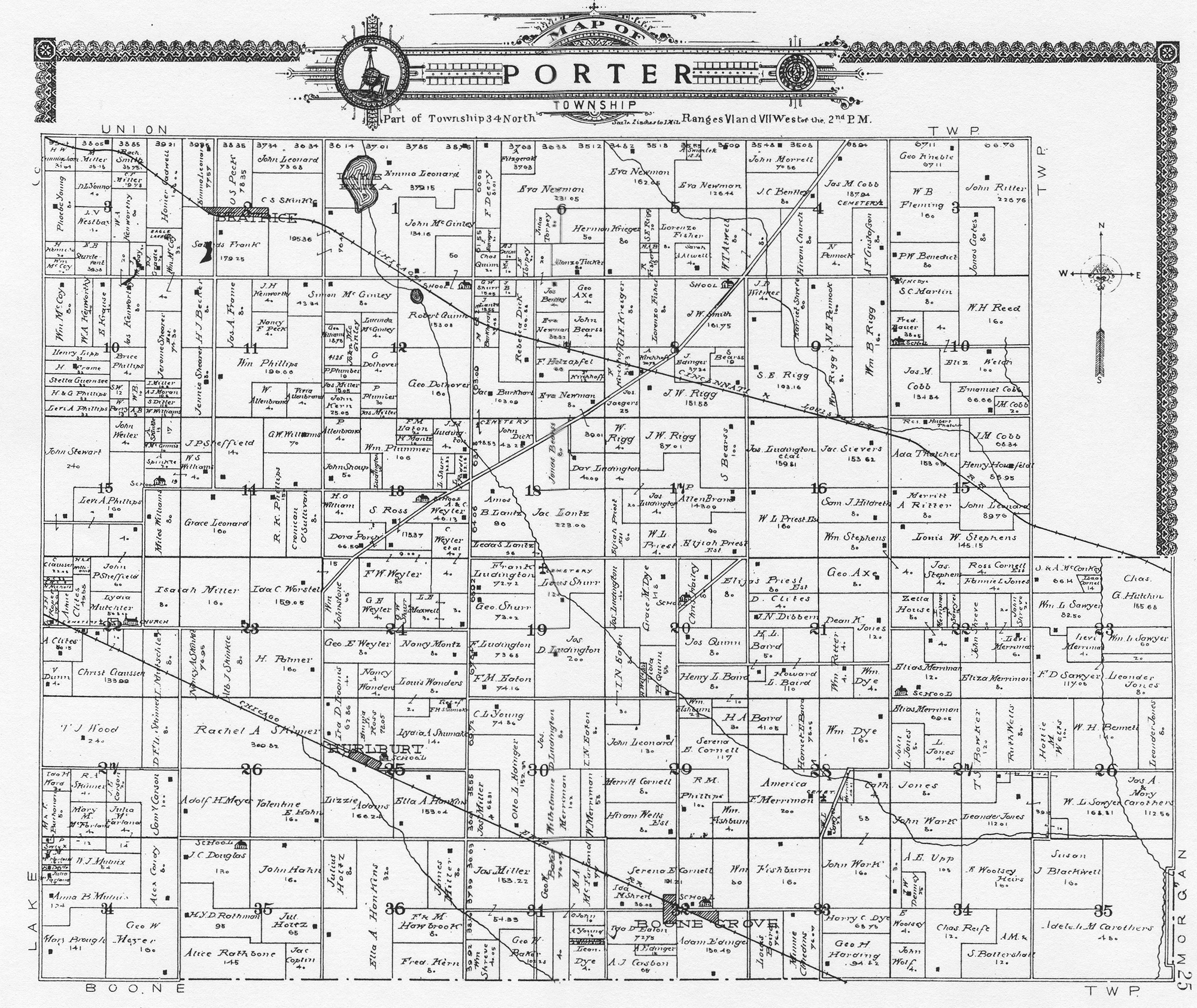
This 1906 map shows the location of the Hankins farm, where the illegal hunting took place, near the town of Hurlburt. It also shows the location of Amos’ farm near Boone Grove.

Hurlburt detail mapDetail of 1906 plat map, Porter Township, Porter County, Indiana.[4] (Click on image to enlarge)

Hurlburt was little more than a post office and a train depot. In 1910 it had a population of over 100.[5]

As a side note, the Hankins farm was established in 1882 by Albert Hankins.[6] He owned a gambling house in Chicago and raised racing horses at his farm in Porter County. He died in 1897 in a bizarre manner, as described in the Westchester Tribune:  [7]

DEATH BY STRANGULATION.
Albert Hankins Suffocates Before His Body is Extricated From The Folding Bed. Woman Who Could Have Saved Him Delays in Giving the Alarm and Mysteriously Disappears From The Scene
— Career of the Noted Gambler
“Farmer” Al Hankins, race horse man, speculator, philosopher, was a victim of the treacherous folding bed, having been smothered to death Wednesday afternoon, Aug. 25, at 1 o’clock in a room in the rear of his gambling place, 3908 Cottage Grove avenue, Chicago.
The sole witness of the accident, the only person who could, by timely warning, have prevented its fatal termination was a woman who rather than risk a confession of her identity, delayed in giving an alarm and mysteriously disappeared from the scene. The personality of the woman is shrouded behind a cloak of doubt and shielded by the care of a few who know who she is, and are familiar with the circumstances which brought here [sic?] within the scope of the tragedy.

You can read an extended version of this dramatic story and a summary of “Al” Hankins’ life in this Chicago Tribune article of August 26, 1897. This lovely illustration of his farm comes from the 1882 book, Counties of Porter and Lake, Indiana.[8]

Hankins farm Porter twp
(Click on image to enlarge)

I hope my readers will forgive this slight detour from the original subject of this post. Sometimes one interesting story leads to another. Genealogists refer to these as “BSOs” – bright shiny objects!

I’ll have more to say about Amos in the future. I was happy to see, as I’m sure are his descendants, that he did the right thing and refused the bribe.

[1] “Chicago Hunters Arrested,” The Lake County Times (Hammond, Indiana), 21 Aug 1913, p. 1, col. 3; image, Library of Congress, Chronicling America (http://chroniclingamerica.loc.gov : accessed 1 Mar 2017).
[2] “New York Passenger Lists, 1820-1891”, browsable images, FamilySearch (https://familysearch.org/ark:/61903/3:1:939V-51S2-X5?i=106&cc=1849782 : accessed 10 November 2016), image 107 of 341, line 27, James Custon; citing NARA microfilm publication M237.
[3] “Indiana Marriages, 1811-2007”, databased with images, FamilySearch (https://familysearch.org/ark:/61903/1:1:KDHQ-DK8 : accessed 16 February 2016), Amos J Casbon & Carrie B Aylesworth, 28 Nov 1900; citing citing Porter, Indiana, county clerk office; FHL microfilm 1,686,211.
[4] “Map of Porter Township”(N.p., n.p., 1906), image, Porter County, Indiana (http://www.inportercounty.org/Data/Maps/1906Plats/Porter-1906.jpg : accessed 2 March 2017).
[5] History of Porter County, Indiana: A Narrative Account of its Historical Progress, its People and its Principal Interests (Chicago: Lewis Publishing Company, 1912), vol 1, p.172.
[6] Weston A.Goodspeed & Charles Blanchard, Counties of Porter and Lake, Indiana: Historical and Biographical, Illustrated (Chicago, Illinois: F. A. Battey & Company, 1882), 383.
[7] “Death by Strangulation,” The (Porter, Indiana) Westchester Tribune, 4 Sep 1897, p. 1, col. 1; transcription, “Albert Hankins, Obituary/Death Notice,” Porter County, Indiana (http://www.inportercounty.org/Data/Obits/Hankins2558.html : accessed 2 March 2017).
[8] Goodspeed & Blanchard, Counties of Porter and Lake, Indiana, 135.

Joseph and Lydia (Burgess) Casbon

You might need the Kleenex® for this one.

One goal of genealogy, at least for me, is to keep lives from being forgotten. By writing about them, I hope to recognize, and give context and meaning to their existence, even if there are no living descendants to preserve their memory. Sometimes there is precious little to preserve when it comes to genealogical records.

Such is the case with Joseph Casbon and his wife Lydia. There is such a paucity of records, that I can only provide a bare outline of their lives. Unfortunately, those few records tell a depressing story

Until I was given a very old hand-written family history last year, I didn’t know if or how Joseph was related to the other Casbons. I wrote about this in a post titled “From England to Indiana, Part 2.” Joseph was listed as the son of Isaac Casbon (1773–1825), and brother to Thomas (1803–1888), William (1806–1875), and James (abt. 1813–1884). The only description given of Joseph was this: “dead he left no heirs.”[1]

Other than this family history, the only two records I have that mention Joseph by name are those documenting his marriage and his burial. The first of these records his marriage to Lydia Burgess in 1835.[2]

1835 Joseph Casbon Lydia Burgess M Royston Marriage record of Joseph Casbon and Lydia Burgess, October 17, 1835, Parish of Royston (Hertfordshire & Cambridgeshire, England). (Click on image to enlarge)

A little information can be gleaned from this record. We can see that Joseph was a resident of Melbourn parish (just outside of Meldreth) and a bachelor. Lydia was “of this parish” (Royston) and a spinster – meaning an unmarried woman. Both Joseph and Lydia signed with their marks, meaning they were not proficient at writing, and possibly could not read. I don’t recognize the names of either of the two witnesses (John Thurley & Phoebe Huggins).

The only other record I have of Joseph is his burial in Meldreth March 7, 1847.[3]

1847 Joseph Casbon Bu MeldDetail from Meldreth Parish register, burials 1847. (Click on image to enlarge)

The burial record tells us that Joseph was still a resident of Melbourn, and that he was 36 years old when he died. This is useful information, because I’ve never been able to find a record of his baptism. Assuming the age is correct, we can estimate that he was born in 1810 or 11, and that he was about 24 years old when he married Lydia.

For Lydia, in addition to the marriage record, I have two census entries, birth registrations for her children, and a burial record. The first of these is the 1841 England and Wales census.[4]

Lydia Burgess Casbon 1841 Census Melb Detail from 1841 census of England, Melbourn, Cambridgeshire. (Click on image to enlarge)

The census tells us that Lydia lived in Chiswick End, a street lies roughly in between Melbourn and Meldreth proper.

Meldreth ord surv map 1945 color detailMap detail showing location of Chiswick End, from Ordnance Survey of Great Britain New Popular Edition, Sheet 148 – Saffron Walden. This work is based on data provided through www.VisionofBritain.org.uk and uses historical material which is copyright of the Great Britain Historical GIS Project and the University of Portsmouth.

The 1841 census also shows that Lydia was 28 years old and was born outside of Cambridgeshire (the “No” in the right-hand column). Two children were in the home: Ann, age 2, born in Cambridgeshire; and Mary, 6 months, also born in Cambridgeshire.

For an unknown reason, Joseph is not recorded in this census. The census only recorded those who were physically present in the household at the time of the census. If a family member was visiting relatives or working elsewhere, they could be recorded at whichever location they occupied on the day of the census (more accurately the night of the census, but that’s another story). Some records have been lost or are too illegible to read. At any rate, I haven’t been able to find an entry for Joseph anywhere in England in the 1841 census. He must have been around, since Lydia continued bearing children (presumably his) through 1844.

In the 1851, Lydia was living in “M[elbourn] in Meldreth,” and listed as: head of household, widow, age 39.[5]

Lydia C 1851 meldreth census Detail from 1851 census of England, Melbourn, Hertfordshire. (Click on image to enlarge)

Her status is widow makes sense, given that Joseph died in 1847. In addition, she is described as a “Pauper,” meaning she was dependent on public support. Her birthplace is listed as Chrishall, Essex. Daughter Ann is not recorded, but Mary, now age 10, is there, along with a new daughter Emma, age 6. Both daughters were born in Meldreth. From these two censuses, we can estimate that Lydia was born in 1812 or 13. I’ve searched online for records of her birth in and around Chrishall, Essex, in this timeframe, without success.

Three children are mentioned in the two census records. I haven’t found baptismal records for any of them, but in the course of researching for this post, I was able to find civil registrations of their births. Birth registrations were required in England beginning in 1837. Births in Meldreth and Melbourn were registered in nearby Royston, Hertfordshire. The online birth registration index contains limited information – only name, year, quarter of birth, and mother’s maiden name. Individual birth records with complete information can be purchased from the General Register Office, but I haven’t done so.

In addition to the daughters listed in the census, I found a birth registration for a fourth child, also a daughter. Sadly, I also found burial records in Meldreth for three of these four children. Here is a summary of the four daughters’ lives:

  • Harriet Ann (“Ann” in the 1841 census): born 4th quarter, 1838;[6] buried August 15, 1850, age 11.[7] Her death explains her absence from the 1851 census.

  • Mary: born 1st quarter, 1841.[8] Orphaned at age 10, she survived to adulthood. Her immigration to the United States and subsequent marriage to William Slocum is described in “From England to Indiana, Part 8.”

  • Hannah (not in either census record): born 4th quarter, 1842;[9] buried June 6, 1848, age 5.[10]

  • Emma: born 4th quarter, 1844;[11] buried April 9, 1852, age 7.[12]

Lydia was buried in June, 1851, just a couple months after the census was taken.[13]

Lydia C Burial 1851 MeldrethDetail from Parish of Meldreth, Bishop’s transcripts for Meldreth, 1599-1862, FamilySearch (https://familysearch.org/ark:/61903/3:1:3Q9M-C9T9-NXZK?mode=g&i=287&cc=1465708&cat=1108704 : accessed 28 February 2017) (Click on image to enlarge)

Her age on the burial record does not match her estimated year of birth from the census records, but this must be her. There was no one else in England with her name and the same approximate age.

What happened to this family? Five of six family members were buried within the span of five years. They could have died from a variety of causes, but my guess is that they suffered from what was then known as consumption (tuberculosis), a disease aggravated by conditions associated with poverty: living in close quarters, poor sanitation, and malnutrition.

On the other hand, after the loss of her husband and two daughters, and with another probably very sick at home, is it too much to believe that Lydia might have died from a broken heart?

[1] Author unknown, photocopy of untitled, undated, handwritten family tree describing descendants of Isaac and Thomas Casbon, 1890-92 (estimated), p. 1, line 5; privately held by Jon Casbon [Address for private use], 2017; photocopy was given to Jon Casbon by Donald A Casbon [Address for private use] in 2016; source and location of original is unknown.
[2] Parish of Royston (Hertfordshire and Cambridgeshire, England), “Register of Marriages [1813–1837],” p. 89, Joseph Casbon & Lydia Burgess, 17 Oct 1835; database with images, “Hertfordshire Marriages,” findmypast (http://www.findmypast.com : accessed 3 February 2017).
[3] Parish of Meldreth (Cambridgeshire, England), parish registers, 1681-1877, Joseph Casbon burial (1847); FHL microfilm 1,040,542.
[4] 1841 census of England, Cambridgeshire, Melbourn, p. 14 (stamped), Lydia Casbon; image, findmypast (http://www.findmypast.com : accessed 21 July 2016); citing [The National Archives] HO 107, piece 63, book 15, folio 14, p. 22.
[5] 1851 census of England, Hertfordshire, Melbourn, p. 29 (stamped), Lydia Casbon; image, findmypast (accessed 21 July 2016); citing [The National Archives] HO 107, piece 1708, folio 206, p. 29.
[6] HM Passport Office, database, Search the [General Register Office] GRO Online Index (https://www.gro.gov.uk/gro/content/certificates/indexes_search.asp : accessed 28 February 2017), birth of Harriet Ann Casbon (1838); citing Hertfordshire, December quarter 1838, Royston & Buntingford district, vol. 6: 463.
[7] Parish of Meldreth, parish registers, 1681-1877, Harriet Anne Casbon burial (1850); FHL microfilm 1,040,542.
[8] GRO Online Index (accessed 28 February 2017), birth of Mary Casbon (1841); citing Hertfordshire, March quarter 1841, Royston & Buntingford district, vol. 6:553.
[9] GRO Online Index (accessed 28 February 2017), birth of Hannah Casbon (1842); citing Hertfordshire, December quarter 1841, Royston & Buntingford district, vol. 6:530.
[10] Meldreth parish registers, Hannah Casbon burial (1848); FHL microfilm 1,040,542.
[11] GRO Online Index (accessed 28 February 2017), birth of Emma Casbon (1844); citing Hertfordshire, December quarter 1841, Royston & Buntingford district, vol. 6:540.
[12] Meldreth parish registers, Emma Casbon burial (1852); FHL microfilm 1,040,542.
[13] Meldreth parish registers, Lydia Casbourn burial (1851); FHL microfilm 1,040,542.

Stuck on John

Genealogists use the term brick wall to describe a situation where they cannot find the information needed to trace an ancestor. That’s where I’m at with John, the father of Thomas Casbon (1843—1799) of Meldreth. John is my sixth great grandfather.

John 4 gen chart
Summary diagram, descendants of John Casbon (Click on image to enlarge)

I’ve used charts like this before to show the relationships of people I’ve discussed. You’ll notice that I don’t have birth or death information for John on the far left. That’s the brick wall I’m talking about. I don’t know when or where John was born, and I’m not sure when he died.

To demonstrate how I’ve tried to solve the problem, I’ll start with the known and work back to the unknown. Here’s what I know about John. The Meldreth parish registers have baptismal records for five children born to John and his wife Ann:

“Thomas Son of John & Ann Casbel was Baptiz’d Dec.r ye 11th” [1743][1]
“James Son of John & Anne Casbell was baptized Jan.9th” [1747][2]
“Nov: 6. James Son of John & Anne Casbull” [1748][3]
“M[ar]ch ye 10.th Mary Daughter of John & Ann Casball” [1751][4]
“Sept.23 … Anna daug.r of John & Ann Casburn” [1754][5]

The first son named James must have died in infancy, since the next son was given the same name. Thomas was the subject of an earlier post. His descendants have been the subjects of many posts.

The next step in is to find a marriage record between John Casb(*) and Ann (? surname) within a few years preceding Thomas’ baptism in 1743. There are no such records in Meldreth or Melbourne. However, I was eventually able to locate this record in the parish register of Wimpole, a tiny village 2.7 miles northwest of Meldreth.[6]

John C Anne Chamberlain M Wimpole 1742
Detail of marriage record, 1742/3; Parish of Wimpole (Cambridgeshire), Bishop’s Transcripts. “John Casborn of the parish of Meldreth and Ann Chamberlain of this Parish were married by Banns January the 18.” (Click on image to enlarge)

This is almost certainly the right couple, given the proximity of the marriage date to the birth of their first child, and given the statement that John belongs to the parish of Meldreth. I could not find any marriage records that might contradict this evidence.

The next step is to try to find baptismal records for John and Ann. This turned out to be fairly easy for Ann. I could not find any records for Chamberlain in Wimpole, where John & Ann were married. On the other hand, there were many Chamberlain records in Meldreth, including this one.

Ann C baptism 1717_18
Detail of baptismal record, 1717/18; Parish of Meldreth (Cambridgeshire). “Anne daughter of William & Elizabeth was Baptized March 9th – 1717.”[7] (Click on image to enlarge)

The date of birth would have made Ann about 24 years old when she was married, and about 36 when she had her first child, so this fits in well with the available data. By the way, you may have noticed in the baptismal record that the dates for 1717 begin and end in March. That’s because at that time in England the legal new year began on March 25th (Lady Day).[8] In addition, England was using the old Julian calendar, which calculated leap years incorrectly.[9] This was corrected by the Calendar Act of 1750, which came into effect in 1752.[10]

To be fair, I also found two baptismal records for Ann Chamberlain in the village of Wrestlingworth, Bedfordshire, in the years 1710 and 1713, respectively. Wrestlingworth is about 5.6 miles west of Wimpole and 7.2 miles west of Meldreth. It is possible that one of these could have married John instead of Ann of Meldreth, but the latter is more likely. Also, there are no burial or marriage records to suggest that Ann of Meldreth died or was married to anyone else.

I don’t know why Ann was living in Wimpole at the time, but it was probably for employment. There was a very large estate at Wimpole (think Downton Abbey!) at the time, now part of the National Trust.[11] Such a large household would have required many servants – a good reason for Ann to be there.

Finding a baptismal record for John is where the brick wall comes into play. The problem is that there are too many candidates. Assuming that John was a bachelor when he was married in 1742/3 (likely but not certain), he was probably born sometime between 1700 and 1725. Meldreth parish registers list two baptisms for John Casb(*) in this time frame:

“June the 8th [1707] the two children of William Cassbell deceased and of Anne his wife were Baptized the eldest born October 1701 was Baptized John the youngest born March 6th 1702 was Bap. William”[12]
“John the Son of John Cassbell and of Anne his wife was Baptized May the 26th [1714]”[13]

To complicate matters further, in the nearby village of Orwell (2.5 miles north of Meldreth), the baptism of John Casborn, son of Thomas and Mary, was recorded on November 26, 1721.[14] If I extend the distance or age range a little bit, the list of candidates grows considerably. However, I think we can limit the list to these three.

How can we tell which one married Ann Chamberlain? I don’t have an answer, but there is information that might help us to narrow it down a bit.

The first John, born in October 1701 and baptized in 1707, became an orphan when his widowed mother died In 1718.[15] John would have needed to become self-sufficient pretty quickly if he wasn’t already. He seems a less likely candidate for Ann’s husband because of his age – 41 would have been pretty old to be getting married for the first time. It’s also possible he died at an early age. One of these two burials might have been him.

“John Cassbell Servant at Bassingbourn was buried in Woolen December the 3d [1724]”[16]
“John Cassbell, a poor shoemaker was buried in Woolen March the 26th 1727”[17]

Unfortunately, I just don’t have enough information to draw any firm conclusions.

Based on his date of birth, the second John, baptized in 1714, could be the one who married Ann. I think he would have been too young to be the servant who died in 1724 or the shoemaker in 1727. However, I’ve searched far and wide for any other records that might be related to him and have come up blank.

At first, John Casborn of Orwell might not seem a likely candidate because he was not baptized (or presumably born) in Meldreth. In addition, there is evidence that his parents continued to live in Orwell for the rest of their lives – well after John and Ann were married.

But there is even stronger evidence in favor of this being the right John. The first is this death record from 1796.[18]

John C burial Meld 1796 age 75
Detail of burial record, 1796, Meldreth Parish registers 1681-1877. “John Casborn, Parish Clerk, Aged 75 _____ Jan.y 4.” (Click on image to enlarge)

If you calculate the birth year from this record, John Casborn was born about 1721 – the same year as John Casborn of Orwell. There are no other baptisms recorded for John Casb(*) around this time in the local area, so this provides strong evidence that John, born in Orwell, became the parish clerk and lived in Meldreth. There is no indication of when he was appointed or how long he served in this capacity.

Another piece of evidence is the fact that he named his first-born son Thomas. It was common practice at the time to name first-born sons after their paternal grandfather.[19] John of Orwell’s father was named Thomas, while the fathers of John born 1701 and 1707 were named William and John, respectively. These naming conventions were not required, nor were they consistently followed. So while suggestive, the fact that John and Ann’s first son was named Thomas doesn’t prove anything. The fact that their first daughter was named Mary (John of Orwell’s mother’s name) is also suggestive, although the naming convention would have given her the name of Elizabeth (Ann’s mother).

Another piece of evidence, though weak, is geography. Orwell is less than 1 mile away from Wimpole. If John was living in Orwell at the time Ann came to Wimpole, they could have easily met. On the other hand, if John became the parish clerk of Meldreth at an early age, he could have met Ann while she was still living in Meldreth.

[googlemaps https://www.google.com/maps/d/embed?mid=11AQDptPhSEw5F-jk5Ea–CWMA9o&w=640&h=480]
Map showing locations of Meldreth, Orwell, Wimpole, and Wimpole Estate (Google Maps)

So, to summarize, there are at least three candidates for John Casb(*), who married Ann Chamberlain in 1642. Of these, John born in 1701 seems the least likely. Of the remaining two, my money is on John, baptized in Orwell 1721. But without better evidence, I just can’t say for sure. So for now, this is where my family tree for the Meldreth Casbons comes to a dead end.

[1] Church of England, Meldreth Parish (Cambridgeshire, England), Parish registers for Meldreth, 1681-1877, Thomas Casbel baptism (1743); FHL Film #1040542.
[2] Church of England, Meldreth Parish, James Casbell baptism (1746).
[3] Church of England, Meldreth Parish, James Casbull baptism (1748).
[4] Church of England, Meldreth Parish, Mary Casball baptism (1751).
[5] Church of England, Meldreth Parish, Anna Casburn baptism (1754).
[6] Church of England. Wimpole Parish (Cambridgeshire, England), Bishop’s transcripts for Wimpole, 1599-1857, Casborn–Chamberlain marriage (1742); digital images, FamilySearch (https://familysearch.org/ark:/61903/3:1:3QS7-89PH-H6G9?i=121&cat=1317069 : accessed 7 June 2016), image 122 of 799.
[7] Church of England, Meldreth Parish (Cambridgeshire, England), Bishop’s transcripts for Meldreth, 1599-1862, Anne Chamberlain baptism (1717/18); digital images, FamilySearch (https://familysearch.org/ark:/61903/3:1:3Q9M-C9T9-NFVL?mode=g&i=173&cc=1465708&cat=1108704 : accessed 16 February 2017), image 174 of 899.
[8] Wikipedia (https://en.wikipedia.org), “Calendar (New Style) Act 1750,” rev. 13:33, 22 January 2017.
[9] FamilySearch Wiki (https://familysearch.org/wiki), “England Calendar Changes,” rev. 20:49, 25 December 2015.
[10] Wikipedia, “Calendar (New Style) Act 1750,” rev. 13:33, 22 January 2017.
[11] Caroline Norton, “Wimpole Hall—Upstairs and Downstairs,” The (Cambridge Family History Society) Journal 19 (April 2013): 12–16; PDF image, Cambridge Family History Society (https://cfhs.org.uk/journals/Volume%2019%20Number%202%20April%202013.pdf : accessed 16 February 2016).
[12] Church of England, Meldreth Parish (Cambridgeshire, England), Parish registers for Meldreth, 1681-1877, John & William Cassbell baptism (1707); FHL Film #1040542.
[13] Church of England, Meldreth Parish, John Cassbell baptism (1714).
[14] “England Births and Christenings, 1538-1975,” John Casborn, 26 Nov 1721, database, FamilySearch (https://familysearch.org/ark:/61903/1:1:N821-Z31 : accessed 6 November 2015); citing Orwell, Cambridge, England, reference items 9-10; FHL microfilm 1,040,543.
[15] Church of England, Meldreth Parish, Ann Cassbell burial (1718); FHL Film #1040542.
[16] Church of England, Meldreth Parish, John Cassbell burial (1724).
[17] Church of England, Meldreth Parish, John Cassbell burial (1727).
[18] Church of England, Meldreth Parish (Cambridgeshire, England), Bishop’s transcripts for Meldreth, 1599-1862, John Casborn burial (1796); digital images, FamilySearch. (https://familysearch.org/ark:/61903/3:1:3Q9M-C9T9-NF6Z?mode=g&cc=1465708 : accessed 16 Feb 2017), image 257 of 899.
[19] FamilySearch Wiki (https://familysearch.org/wiki), “British Naming Conventions,” rev. 06:29, 3 February 2016.

James Casbon of Meldreth (~1772-1833)

I have discussed my 4th great-grandfather Isaac (“From England to Indiana, Part 2”) and his father Thomas (“Stepping back: Thomas Casbon, 1743-1799”). Today I will focus on Isaac’s older brother James, baptized as James Casbull on July 19, 1772 in Meldreth. [1]

James C bapt 1772 Meld
Baptismal record of James Casbull (Click on image to enlarge)

He is an important link in ‘Our Casbon Journey’ because of his many descendants. Like his brother Isaac, the available records are limited to baptism, marriage, burial, and the baptisms of his children.

Being the son of a laborer, James probably started working at an early age to help support the family. Although no records show his occupation, he was almost certainly a laborer as well.

James married Ann Ward in Great Eversden, Cambridgeshire on October 19, 1793. [2] Great Eversden is a tiny village about 4 miles north of Meldreth.

http://www.geograph.org.uk/more.php?id=3149316
Parish Church of Saint Mary, Great Eversden, Cambridgeshire, completed in 1470. © Copyright John Salmon and licensed for reuse under this Creative Commons License (Click on image to enlarge)

At first I could not be sure this was the right James, until I located this copy of the marriage record on Ancestry. [3]

james c ann ward marrage 1793
(Click on image to enlarge]

When I saw that the marriage was witnessed by Thomas (either James’ father or brother) and Isaac Casbon, I knew I had my man!

Unfortunately, I can’t trace Ann Ward with certainty. It is a very common name. There are two baptismal records for Ann Ward from 1771, one in the village of Orwell, about 2 miles from both Meldreth and Great Eversden, and the other in Croydon cum Clapton, about 4 miles from Meldreth and Great Eversden. [4],[5] Most likely, she is the one from Croydon cum Clapton, since I was able to locate a separate marriage record for Ann Ward in Orwell dated 1797. [6]

James and Ann had only one child before Ann died in 1795. [7]

Ann Ward C burial Meld 1795
Burial record of Ann (Ward) Casbon February 18, 1795, Meldreth (Click on image to enlarge)

Their daughter Ruth was baptized March 17, 1794 in Meldreth. [8]

Left with an infant child, it didn’t take long for James to remarry, this time to Mary Howse, on November 23, 1796. [9]

1796 James Casbon Mary Howse M Meld
Marriage record of James Casbon to Mary Howse (Click on image to enlarge)

Look back up at the first image in this post. There is Mary Howse’s baptism in the second entry! It’s tempting to think that Mary was related to Susanna Howes, the wife of James’ brother Isaac. If such a connection exists, I haven’t found it yet. Mary was born and raised in Meldreth, and Susanna was born and raised in nearby Bassingbourn. Nevertheless, I think there’s a good chance they were cousins.

James and his new wife Mary had three more children: Mary (baptized 1798 in Meldreth), [10] Nancy (or Ann – baptized 1800 in Meldreth), [11] and James Howse Casbon (born 1806 in Meldreth). [12] Mary married William Wood in Meldreth 1817. [13] Nancy (then known as Ann) married John Prime in Meldreth 1823. [14] Of son James, we shall hear more in a future post.

The only remaining records for James and Mary are for their burials. James was buried March 10, 1833 in Meldreth. [15]

James C bp 1772 bu 1833 Meld
Burial record of James Casbon, 1833, Meldreth (Click on image to enlarge)

His widow Mary followed James in death in 1837, also in Meldreth. [16]

[1] Church of England, Parish Church of Meldreth, “Bishop’s transcripts for Meldreth, 1599-1862.” FamilySearch https://familysearch.org/ark:/61903/3:1:3Q9M-C9T9-NF4G?i=235&cat=1108704 [accessed 12 May 2016]
[2] “England Marriages, 1538–1973”, FamilySearch https://familysearch.org/ark:/61903/1:1:NVCJ-BYX [accessed 5 November 2016]
[3] “England, Select Marriages, 1538–1973”, Ancestry http://www.ancestry.com [accessed 26 October 2016]
[4] “England Births and Christenings, 1538-1975,” FamilySearch https://familysearch.org/ark:/61903/1:1:J7HV-M9M [accessed 17 December 2016]
[5] “England Births and Christenings, 1538-1975,” FamilySearch https://familysearch.org/ark:/61903/1:1:J93G-SHR [accessed 17 December 2016]
[6] “England Marriages, 1538–1973 ,” FamilySearch https://familysearch.org/ark:/61903/1:1:NVC6-TZK [accessed 17 December 2016]
[7] “Bishop’s transcripts for Meldreth, 1599-1862.” FamilySearch https://familysearch.org/ark:/61903/3:1:3Q9M-C9T9-NXFR?i=255&cat=1108704 [accessed 4 November 2016]
[8] Church of England. Parish Church of Meldreth, “Parish registers for Meldreth, 1681-1877,” Baptisms 1794. FHL microfilm #1040542
[9] “Parish registers for Meldreth, 1681-1877,” Marriages 1796.
[10] “Parish registers for Meldreth, 1681-1877,” Baptisms 1798.
[11] “Parish registers for Meldreth, 1681-1877,” Baptisms 1800.
[12] “Parish registers for Meldreth, 1681-1877,” Baptisms 1806.
[13] “Parish registers for Meldreth, 1681-1877,” Marriages 1817.
[14] “Parish registers for Meldreth, 1681-1877,” Marriages 1823.
[15] “Parish registers for Meldreth, 1681-1877,” Burials 1833.
[16] “Parish registers for Meldreth, 1681-1877,” Burials 1837.